Dreams in Therapies
We went a bit through the history of dream interpretation in our article “A bit of history of dream interpretation.” Still, around the 20th century, many interesting theories about dream interpretation came out. Psychologists from Europe and the occidental world, in general, tried to understand the meaning behind dreams and how to use them in therapy.
These theories are still used today, mostly in psychoanalysis, and other therapy approaches. Here we’ll try to explain the basics of the main theories and how they’re used in therapy.
Do therapists still actually do this?#
Worth answering before the theory, because the answer is not a straightforward yes.
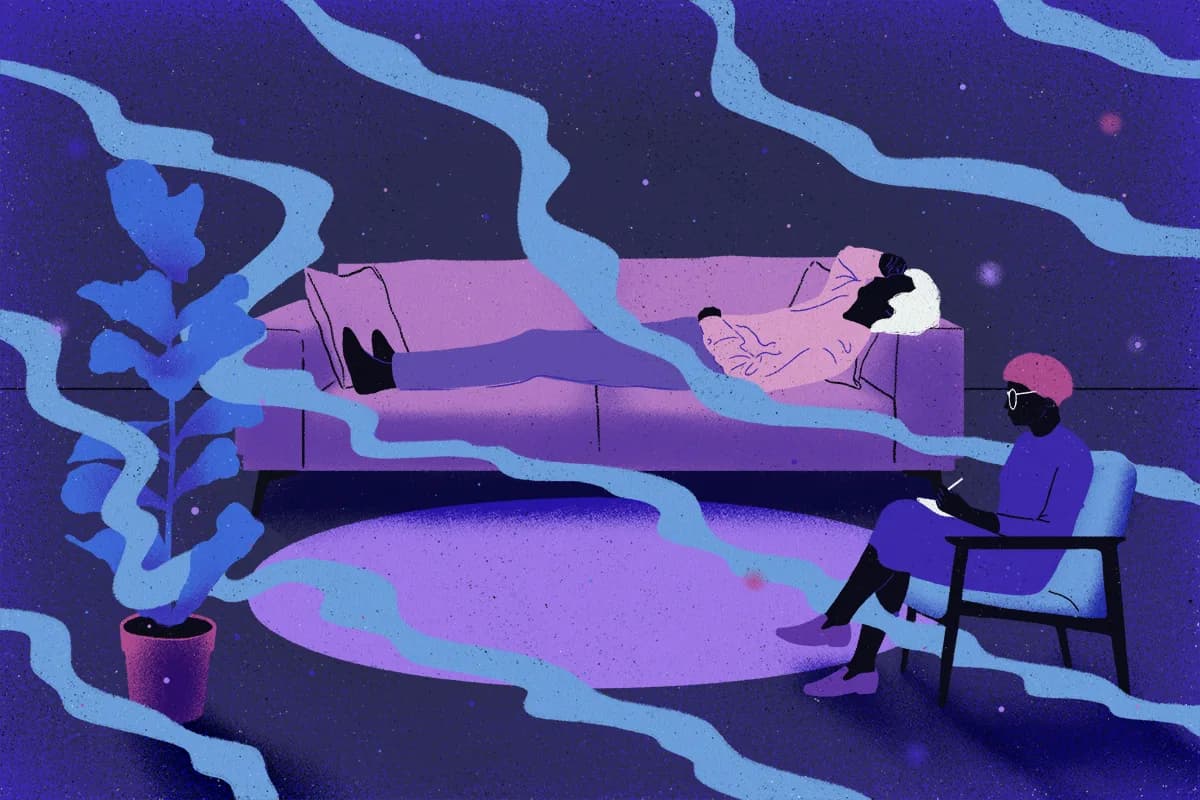
Where dream work happens, it happens a lot. A survey of psychotherapists in private practice found that dreams came up in around 28% of sessions, and that clients raised the dream about twice as often as the therapist did. It also turned out that therapists who worked on their own dreams were far more likely to work on their clients'.[1] Dream work travels through practitioners who practise it themselves.
The broader trend runs the other way, though. Dreams have drifted to the margins of clinical psychology over the past several decades. Researchers tracing why point at history rather than evidence: psychology's early push to distinguish itself from psychoanalysis by aligning with behaviourism and the natural sciences, and a narrow definition of what counts as evidence-based practice.[2] The result is that clients keep bringing dreams to therapy while many psychologists report feeling unequipped to do anything with them.[3]
So if a therapist has told you dreams aren't really their thing, that's a fair description of the field. It isn't a verdict on whether the material is useful. Structured dream work does have outcome research behind it,[4] including a controlled comparison where working on a recent dream produced significantly more personal insight than working on a recent waking event.[5] Some of the benefit likely runs through the therapeutic alliance itself, one of the strongest predictors of outcome in any therapy,[6] since spending a session on someone's dream is an unusually attentive thing to do.
Freud: the royal road to the unconscious#
The most famous is probably the one from Sigmund Freud, the father of psychoanalysis. According to Freud, dreams are an expression of the unconscious mind, therefore of our deep wishes. These wishes, that Freud called “latent content” of the dream, are too forbidden and are thus disguised by the “manifest content,” aka what we actually dream of. Basically, if you dream of X, it means Y.[7,8] In his book “The interpretation of dreams,” he explains how the latent content is hidden through the four elements of what he calls the “dream work.” We’ll try to make them simple:
- Condensation is when many concepts are combined in one image, like when your parents and your boss are the same person, representing authority.
- Symbolization is something standing for something else; like flying represents ambition.
- Displacement is when important things are changed in something else less relevant; like if you’re hesitating for an important life decision you might dream of choosing between pizza or hamburger for dinner.
- And lastly, Secondary revision is when, at the end of the dream, all elements are reorganized and show the manifest content.
Freud used to ask his patients to tell the dream and then make free connections between elements so that the “latent content” would come out spontaneously and give an interpretation.[9]
Jung: compensation and archetypes#
Carl Jung was Freud’s student, and they were even friends before Jung elaborated his own theory about dreams. Unlike Freud, Jung thought that dreams were more an expression of a person’s desire to balance their personality and serve as compensation between conscious and unconscious. So, to protect our personality, they would show the opposite of the attitudes of the waking life, for example, dream of humiliation like being naked in public when you have been a bit too confident lately.
Another critical element of Jung’s theory is the collective unconscious which, with the individual unconscious, would emerge in dreams and could help anticipate future issues in life. It would express through archetypes, symbolic images culturally shared like, for example, the symbol of death. mJung’s method for interpreting dreams consisted of looking for amplifications on three levels in people’s dreams. First, he considered the personal context and life of the dreamer: feelings, thoughts, etc. Then their cultural background, age, and environment. And last, the archetypal contents were investigated to find the links between the person and myths, religion, and collective human unconscious in general.[10] By exploring the content of dreams, he would seek their meaning.
Hall and the cognitive theories#
A slightly different approach was proposed by Calvin Hall and some other cognitivist psychologists. In cognitive theories, dreams are a representation of the dreamer’s conceptions of elements of personal life: like themselves, other people, the world, the future, their problems, and impulses.So dreaming is a cognitive process and is subject to the same cognitive distortions as waking life. An example of distortion would be to tend to always expect the worst in situations; in that case, you’ll dream about the worst-case scenario in your dream.
To interpret dreams, Hall developed a scientific method that looked to the figures in the dream, the actions and interactions of the characters, and the dream setting, transition, and outcome.[11] This way he aimed to understand the dreamer, more than the dream. This way, he aimed to understand the dreamer more than the dream. Through these elements, it should be possible to have an accurate representation of the person’s view of the world and their personality and work on their cognitive distortions and maladaptive schemas in waking life.



Sources & References
This article was written based on published research, peer-reviewed studies, and trusted books. Check out the following sources to go further.
[1]The use of dreams in psychotherapy: a survey of psychotherapists in private practice
Schredl, M., et al. · 2000
The Journal of Psychotherapy Practice and Research, 9(2)
[2]The marginalisation of dreams in clinical psychological practice
Leonard, L., & Dawson, D. · 2018
Sleep Medicine Reviews, 42
[3]The use of dreams in modern psychotherapy
Hill, C. E., & Knox, S. · 2010
International Review of Neurobiology, 92
[4]Working with dreams in therapy: what do we know and what should we do?
Pesant, N., & Zadra, A. · 2004
Clinical Psychology Review, 24(5)
[5]Comparing personal insight gains due to consideration of a recent dream and consideration of a recent event
Edwards, C. L., et al. · 2015
Frontiers in Psychology, 6
[6]Therapeutic alliance and outcome of psychotherapy: historical excursus, measurements, and prospects for research
Ardito, R. B., & Rabellino, D. · 2011
Frontiers in Psychology, 2
[7]Dream Interpretation: What Do Dreams Mean?
Verywell Mind
[8]Dream interpretation
ThoughtCo
[9]Freud's Method for Interpreting Dreams
Freud Museum London
[10]Jung's theory of dreams: a reappraisal
2020
Psychology Today
[11]A cognitive theory of dreams
Hall, C. S. · 1953
UCSC Dream Library

Written by
Founder of Oniri
Jean-Baptiste founded Oniri and researches dreams, lucid dreams, creativity, and AI. He collaborates with the Sleep and Cognition Neuroimaging Laboratory in Geneva and is invested in different studies about lucid dreams and the intersection of dreams and AI, including a paper in the Journal of Sleep Research on cathartic dreams.
Share this article