What Is REM Sleep? Its Role in Dreams and Memory
Das Wichtigste in Kürze
- REM sleep, short for rapid eye movement sleep, is the stage of sleep in which the eyes move quickly under closed lids, the brain is almost as active as when awake and most muscles are paralysed.
- Adults spend about two hours a night in REM sleep, in periods that come roughly every 90 minutes and grow longer towards morning.
- Across 35 sleep-lab studies, people woken from REM sleep had a dream or thought to report about 82% of the time, against 43% when woken from non-REM sleep.
- Dreams also happen outside REM sleep, and in both stages they go with the same drop in slow brain activity at the back of the brain.
- REM sleep seems to take the emotional charge out of memories, but its role in memory itself is still debated, because people whose REM sleep is suppressed by medication show no clear memory problems.
Every night you spend a couple of hours in a kind of sleep where your brain is nearly as busy as it is in the daytime. Your eyes flick back and forth under closed lids, and almost every muscle in your body is switched off. That's REM sleep, and it's where most of your vivid dreams happen. It's also the part of the night that sleep scientists still argue about most, even after seventy years of looking at it. Here's what REM sleep is, what happens in it, and how much anyone really knows about what it does for you.
What is REM sleep?#
REM sleep, short for rapid eye movement sleep, is the stage of sleep in which your eyes move quickly under closed lids and your brain is nearly as active as when you're awake, while most of your muscles are paralysed. Every other stage is called non-REM sleep, which runs from the light dozing at the start of the night to the deep, slow sleep you're hardest to wake from. The two take turns all night, and REM gets the smaller share, about two hours a night in an adult.[1]
Over the years researchers have given REM a handful of other names, and each one picks out a different side of it. Active sleep refers to the twitches and dream sleep to the dreams (even though, as you'll see, dreams aren't limited to it). Paradoxical sleep names the strangest part, a brain that looks awake inside a body that's fast asleep. The name that stuck is the most literal one, because the eye movements were the first thing anyone noticed.
What happens during REM sleep#
If you watched someone go into REM sleep, the first thing you'd see is their eyes darting under the lids in short bursts. Their breathing gets quicker and less even, too: in the first lab study of REM, sleepers took about 17 breaths a minute while their eyes were moving, against 13 when their eyes were still.[2] The heart can beat faster, parts of the brain burn more energy, and blood flow to the genitals goes up, in men and women alike.[3]
Meanwhile the brainstem sends out a signal that turns off almost every muscle in your arms and legs. Apart from the odd twitch of a finger or the face, a person in REM lies completely limp. The usual explanation is that this stops you acting out your dreams, and it's easy to see the appeal (nobody wants to sprint into the wardrobe during a dream chase). But some sleep researchers find that story hard to keep, since we also dream outside REM, when our muscles work as normal.
The switch is also why REM sleep can go wrong at its edges. If you wake up while it's still on, you can see the room and think clearly but can't move. That's sleep paralysis, frightening but harmless (the guide to the sleep paralysis demon explains what you might see). If the switch fails during REM itself, people kick, punch and shout their dreams out loud. That's a disorder of its own, called REM sleep behaviour disorder, and it's worth seeing a doctor about.
When REM sleep happens in the night#
Sleep runs in cycles of about 90 minutes, each one going from light sleep down into deep sleep and back up into REM.[4] The mix changes as the night goes on. Deep sleep fills most of the early cycles and REM most of the late ones, so your first REM period is short and your longest come in the last few hours before your alarm. And the dream you wake up from in the morning is so often a long, strange one because you're coming out of the longest REM period of the night.
The flip side is that a short night costs you more REM than deep sleep, because the hours you lose are the ones REM fills. If you want to keep those hours, a regular wake-up time does more than anything else on the list of sleep hygiene habits, even at the weekend, when lying in feels like the reward. How much REM sleep you need, and what to make of the number on a sleep tracker, is a big enough question for an article of its own.

Babies get far more REM sleep than adults do. A newborn spends about eight hours a day in it, roughly as much time as it spends awake, and before birth REM is the brain's main state. By adulthood that has dropped to the two hours you get now.
Do you dream in REM sleep?#
Yes, REM sleep is where you're most likely to dream, and where dreams tend to be the longest and most vivid. Across 35 sleep-lab studies, people woken during REM had a dream or a thought to report about 82% of the time.[5] When they were woken from non-REM sleep it was 43%, which is a lot less often but a long way from never.
Dream recall after waking from REM and non-REM sleep
Share of awakenings with a dream or thought to report
- Woken from REM sleep: 82%
- Woken from non-REM sleep: 43%
Source: Nielsen, 2000[5]. Average of 35 sleep-lab studies.
Non-REM dreams used to be written off as scraps of half-remembered thought, and many of them are thinner and more like thinking than like a story. But the line between the two has blurred. Researchers looked at what the brain was doing just before people reported a dream, and they found the same thing in REM and in non-REM sleep. In both, slow activity dropped in an area at the back of the brain. By watching that one area, they could even tell in real time whether someone woken from non-REM sleep would say they'd been dreaming.[6]
So the old idea that REM sleep equals dreaming is only half right, and the gap matters for your own nights in two ways. First, waking up with no dream to remember says nothing about your REM. Did you get no REM sleep last night, then? You almost certainly had four or five REM periods and simply forgot them, the normal outcome when you don't wake up during one (why we forget our dreams explains how to change that). And second, the flashes of faces and voices you sometimes get as you drift off aren't REM dreams at all. They're hypnagogic hallucinations, which come from the very first minutes of light sleep. Lucid dreams, on the other hand, where you know you're dreaming while it happens, come mostly from REM, and what lucid dreams are covers what they feel like.
What is REM sleep good for?#
Most pages answer this with a tidy list (memory, mood, brain development) and stop there, as if it were settled. It isn't, and the people who study REM say so themselves. They have plenty of theories about what REM does and have ruled out very few. One group of sleep researchers even opened a review of the field with a question you rarely see in a scientific journal.
Indeed, is REM sleep, in any meaningful sense, a thing?
That doesn't mean nobody knows anything about what REM does, because there's good evidence for two of its jobs, and a long argument about a third.
It takes the sting out of emotional memories#
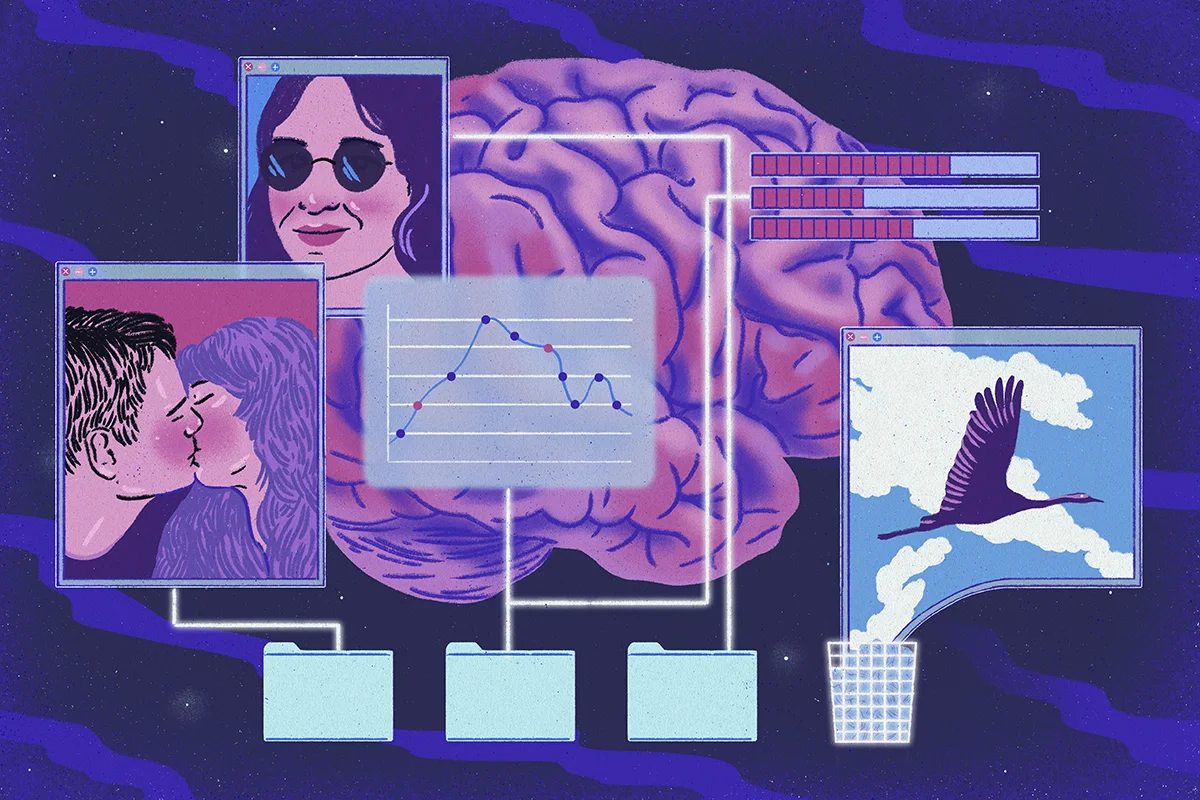
During REM sleep, the brain chemical behind stress and alertness (noradrenaline) is almost completely shut off, while another one, acetylcholine, is as active as it is during the day. One influential idea is that this lets your brain go back over an emotional memory without the stress that came with it, so you keep the memory and lose some of its charge. The argument you had yesterday is still there in the morning, but it no longer makes your chest tighten when you think of it. It's the grown-up version of being told you'll feel better after a night's sleep.
It's a model, and a well-supported one, but it may not be the whole story. Its authors also think it explains what happens when the process fails, as in post-traumatic stress disorder, where the same nightmare can come back night after night because the memory never loses its charge. If that sounds like your nights, the guide to having fewer nightmares goes through the treatment sleep doctors use.
It feeds the developing brain#
The amount of REM sleep babies get (those eight hours a day) led researchers to the idea that REM does something special for a brain that's still being built. The idea gets support from animals, too, because the species born most immature, like rats and cats, are also the ones with the most REM sleep as babies. It doesn't tell you much about what REM does for you as an adult, though, which is where the argument starts.
Its role in memory is still argued over#
Memory is where the evidence pulls in two directions. In one experiment, mice learned where some objects were, and in the hours that followed, researchers used light to quiet one brain rhythm only while the mice were in REM sleep. The mice forgot. Doing the same thing outside REM had no effect at all.[7]
Studies of people point the other way, which is the frustrating part. Some antidepressants suppress REM sleep for years on end, and people who take them, or who have lost most of their REM to a brain injury, don't show memory problems. How much REM a person gets doesn't predict how well they learn, either.[8] So does REM sleep help you remember, or not? The likeliest answer is that memory needs a whole night of sleep, with REM and deep sleep each doing part of the work, and nobody yet knows exactly how the jobs are split. If you're more interested in why we dream than in why we have REM, why we dream goes through the main theories.
How REM sleep was discovered#
For thousands of years the clues were in plain sight, on the eyelids of any napping child and in the twitching paws of any sleeping dog. (Dogs dream too, by the way, and do animals dream has the evidence.) And yet Watson and Crick worked out the structure of DNA before anyone knew much about the state we spend a third of our lives in.
The breakthrough came from a graduate student at the University of Chicago called Eugene Aserinsky, and his first sleeper was his son. One evening in December 1951, eight-year-old Armond lay down on an army cot in the lab with electrodes taped around his eyes. His father settled in next door to watch the pens of an old brain-wave machine. Some hours in, the pens started swinging as if the boy were awake and looking around. Aserinsky went in expecting to find him sitting up, but Armond's eyes were closed and he was fast asleep.
Two years later, Aserinsky and his supervisor, Nathaniel Kleitman, published what they had found. When they woke sleepers during the eye movements, 20 times out of 27 the person described a detailed dream, usually full of images. When they woke them while their eyes were still, 19 times out of 23 the person remembered nothing at all.
Armond, who spent more than one night wired to that machine, said later that he never worried about it, because he knew it couldn't read his mind. It still can't. A sleep lab can now tell you to the minute when you went into REM last night. But to find out what you dreamed there, you'll still have to wake up and tell someone, or record it before it fades.
Häufige Fragen
What does REM stand for in sleep?
REM stands for rapid eye movement, after the quick, jerky movements your eyes make under closed lids during this stage of sleep. The name dates from the early 1950s, when researchers in Chicago saw those movements on their recordings and found that sleepers woken during them usually had a dream to tell. Every other stage of sleep is grouped together as non-REM sleep.
Why is REM sleep called paradoxical sleep?
REM sleep is called paradoxical sleep because the brain looks almost awake while the body is deeply asleep. Recordings of the brain during REM resemble those of a waking person, yet the sleeper is limp, hard to rouse and unaware of the room. It has also been called active sleep, for its twitches, and dream sleep, even though dreams aren't limited to it.
Is REM sleep the same as deep sleep?
No, REM sleep and deep sleep are close to opposites. Deep sleep is the slowest stage of non-REM sleep, when brain waves are large and slow and you're hardest to wake. It takes up most of the first half of the night, while REM sleep, with its busy, wake-like brain, takes over in the second half. A good night has plenty of both.
If you don't remember your dreams, are you still getting REM sleep?
Almost certainly, yes. Anyone with ordinary sleep goes through four or five REM periods a night, whether or not they remember a single dream. Forgetting is the normal outcome, because a dream fades within minutes unless you wake up during it or right after. Waking up slowly and writing down whatever you remember straight away is usually enough to bring dreams back.
What does REM sleep look like from the outside?
From the outside, REM sleep looks like a still body with busy eyes. Under the closed lids the eyes dart from side to side in bursts, breathing becomes faster and less regular, and the face or fingers may twitch, while the big muscles stay limp. If you've ever watched a sleeping dog paddle its paws, you've seen the animal version.



Quellen und Referenzen
Dieser Artikel stützt sich auf veröffentlichte Forschung, peer-reviewte Studien und verlässliche Bücher. Schau in die Quellen unten, wenn du tiefer einsteigen willst.
[1]What is REM sleep?
Blumberg, M. S., Lesku, J. A., Libourel, P.-A., Schmidt, M. H., & Rattenborg, N. C. · 2020
Current Biology, 30(1)
[2]Regularly occurring periods of eye motility, and concomitant phenomena, during sleep
Aserinsky, E., & Kleitman, N. · 1953
Science, 118(3062)
[3]The stubborn scientist who unraveled a mystery of the night
Brown, C. · 2003
Smithsonian Magazine
[4]Overnight therapy? The role of sleep in emotional brain processing
Walker, M. P., & van der Helm, E. · 2009
Psychological Bulletin, 135(5)
[5]A review of mentation in REM and NREM sleep: "covert" REM sleep as a possible reconciliation of two opposing models
Nielsen, T. A. · 2000
Behavioral and Brain Sciences, 23(6)
[6]The neural correlates of dreaming
Siclari, F., Baird, B., Perogamvros, L., Bernardi, G., LaRocque, J. J., Riedner, B., Boly, M., Postle, B. R., & Tononi, G. · 2017
Nature Neuroscience, 20(6)
[7]Causal evidence for the role of REM sleep theta rhythm in contextual memory consolidation
Boyce, R., Glasgow, S. D., Williams, S., & Adamantidis, A. · 2016
Science, 352(6287)
[8]The REM sleep-memory consolidation hypothesis
Siegel, J. M. · 2001
Science, 294(5544)

Geschrieben von
Founder of Oniri
Jean-Baptiste founded Oniri and researches dreams, lucid dreams, creativity, and AI. He collaborates with the Sleep and Cognition Neuroimaging Laboratory in Geneva and is invested in different studies about lucid dreams and the intersection of dreams and AI, including a paper in the Journal of Sleep Research on cathartic dreams.
Artikel teilen