The Function of REM Sleep and Dreams
While we sleep, our brain goes through different cycles and phases, each with a different function. One of these phases is called REM sleep (for “rapid eye movements”), and since it was discovered in the fifties, it has been the most studied phase of sleep. In fact, its crucial functions for our body and our brain, such as brain maturation and memory consolidation, have interested sleep scientists for decades. If this sounds all new to you, we recommend that you read our first article about the subject: What happens to us during sleep and dreams?
As you might already know, REM sleep is the stage where most dreams happen, and these two elements go together. Actually, many studies failed to separate the physical phenomenon, the sleep phase, from the psychological one, dreams, and reviews of the experimental literature note that the neurophysiological correlates of dreaming are still not fully pinned down for exactly this reason.[1] That entanglement is itself a clue: REM sleep and dream function are related.
Deal with emotions and memories#
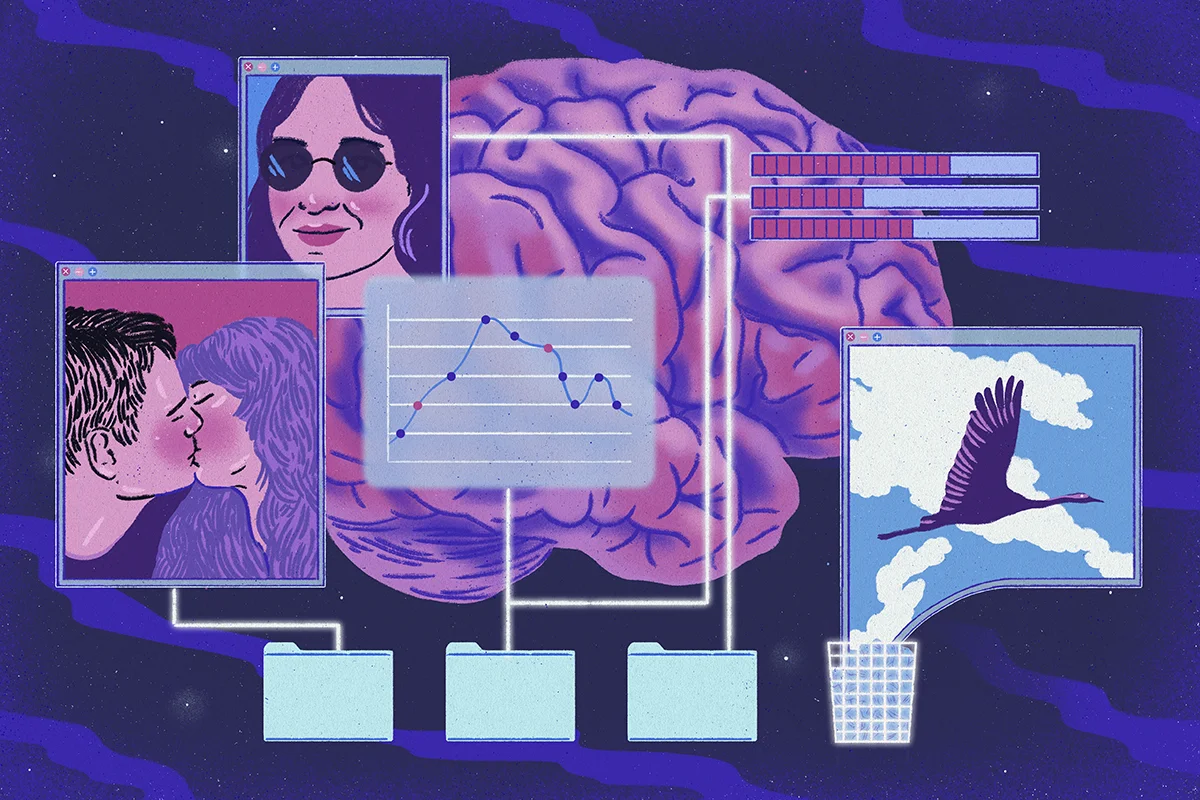
REM sleep is where we consolidate positive and negative emotional memories, more than neutral ones.[2] This is actually made during REM sleep, through dreams.
The strongest evidence for that "through dreams" part comes from a maze. Volunteers learned to navigate a virtual maze, took a nap, then tried again. What predicted improvement wasn't how long they slept: it was whether they dreamed about the maze. The people who did improved dramatically more than the people who didn't, and simply thinking about the task while awake predicted nothing at all. The result was later replicated across a full night's sleep.[3,4] Dreaming about something you learned isn't decoration on top of consolidation. It looks like the process itself, seen from the inside.
In this process, dreams are a “replay” of waking-life emotional events, though replay is a loose word for it. Literal replay is rare: when researchers matched two weeks of daily logs against two weeks of dreams, about 65% of dreams contained some trace of recent waking life, but a real event recurring intact, same people, same place, same story, showed up in 1-2% of dreams at most.[5] What you get instead is fragments, recombined. Brain regions of emotional encoding and consolidation have a strong relationship with dream contents.[6]
But during dreams we don’t only consolidate our memories, we reorganize them. That’s the reason why, in dreams, we experience weird associations between elements of our waking life not really related to each other. That bizarreness has actually been measured rather than just asserted: content analyses of dream reports find bizarre elements are common but not uniform, showing up most in how scenes and objects transform rather than in wholesale nonsense.[7]
This is why, for example, if you had lunch at your grandmother’s and then you played Mario Kart all afternoon, it wouldn’t be so weird to dream of your grandma in a kart racing. This replay and reorganization is crucial, actually we wouldn’t be able to completely consolidate memories if we get deprived of REM stage of sleep and dreams.[8]
Theat Simulation theories#
Memory is not the only function of dreams. Related to emotions, in dreams we experience negative emotions (such as fear and anxiety) twice as much as positive ones.[9] Sad, isn’t it? But this masochism has a central function. An important theory says that dreams could represent a sort of simulation of reality, especially of two specific situations.
The first are dangerous situations and threats. Apparently, this mechanism would go back to the stone age when the possibility to “train” to escape from danger in dreams would have been an evolutionary advantage for survival for our ancestors. Of course, today we don’t dream of running from saber-toothed tigers anymore. Instead, we dream of more contemporary dangerous situations like car accidents, in order to be more careful in daily life.[10]
Social life#
The second kind of simulation would be of social situations, positive and negative. Dreaming of people and situations gives the possibility to create new scenarios of the future and it’s a form of rehearsal for waking social interactions.[11] The fact that dreams incorporate daily events to simulate reality helps us train our problem-solving based on emotional coping strategies even if we don’t always remember it. This way we can face social and emotional situations in waking life.[12] Paying attention to these patterns is also a first step to understanding what your dreams mean.
Conclusion#
Who would have said that these nightly weird products of our brain could have such important purposes? And this is what they do without us being aware of it, but dreams have a lot of other potentials if you know how to exploit them. We tell you all about that in our articles, starting from : Why you should remember your dreams



Kilder og referanser
Denne artikkelen bygger på publisert forskning, fagfellevurderte studier og pålitelige bøker. Ta en titt på kildene under hvis du vil gå dypere.
[1]Experimental research on dreaming: state of the art and neuropsychoanalytic perspectives
Ruby, P. M. · 2011
Frontiers in Psychology, 2
[2]Overnight therapy? The role of sleep in emotional brain processing
Walker, M. P., & van der Helm, E. · 2009
Psychological Bulletin, 135(5)
[3]Dreaming of a learning task is associated with enhanced sleep-dependent memory consolidation
Wamsley, E. J., et al. · 2010
Current Biology, 20(9)
[4]Dreaming of a learning task is associated with enhanced memory consolidation: replication in an overnight sleep study
Wamsley, E. J., & Stickgold, R. · 2019
Journal of Sleep Research, 28(1)
[5]Dreaming and episodic memory: a functional dissociation?
Fosse, M. J., et al. · 2003
Journal of Cognitive Neuroscience, 15(1)
[6]The functional role of dreaming in emotional processes
Scarpelli, S., et al. · 2019
Frontiers in Psychology, 10
[7]A content analysis of bizarre elements in dreams
Revonsuo, A., & Salmivalli, C. · 1995
Dreaming, 5(3)
[8]Characteristics of the memory sources of dreams: a new version of the content-matching paradigm
Vallat, R., Chatard, B., Blagrove, M., & Ruby, P. · 2017
PLOS ONE, 12(10)
[9]Dreaming without REM sleep
Oudiette, D., et al. · 2012
Consciousness and Cognition, 21(3)
[10]The reinterpretation of dreams: an evolutionary hypothesis of the function of dreaming
Revonsuo, A. · 2000
Behavioral and Brain Sciences, 23(6)
[11]Social contents in dreams: an empirical test of the Social Simulation Theory
Tuominen, J., Stenberg, T., Revonsuo, A., & Valli, K. · 2019
Consciousness and Cognition, 69
[12]Are dreams social simulations? Or are they enactments of conceptions and personal concerns?
Domhoff, G. W., & Schneider, A. · 2018
Dreaming, 28(1)

Written by
Founder of Oniri
Jean-Baptiste founded Oniri and researches dreams, lucid dreams, creativity, and AI. He collaborates with the Sleep and Cognition Neuroimaging Laboratory in Geneva and is invested in different studies about lucid dreams and the intersection of dreams and AI, including a paper in the Journal of Sleep Research on cathartic dreams.
Share this article