
How to Start a Dream Journal
Keeping a dream journal is the basis for any good dream work practice. Even the short abstract dreams are worth recording. Good dreams can be just as informative as bad dreams; both can be useful instruments for unlocking the creativity that goes unnoticed during your waking life. Some dream journalers sketch what they see, while others prefer to free-write or even use a voice recorder. Experiment with different modes of dream journaling and decide what works best for you.
Why it works, before we get to how#
If you're not yet convinced this is worth doing every morning, one experiment should settle it.
Researchers took 45 people at a mental health centre who all said they had not recalled a single dream in the past month. Half were asked about their dreams as usual. The other half were simply encouraged to remember them, and nothing else was changed. At the next appointment, 32% of the first group recalled a dream. In the encouraged group it was 68%, more than double.[1]
Nobody in that study kept a journal, changed their sleep, or took anything. They were just told their dreams were worth remembering. That's essentially what a dream journal does, every single day, and it's why the habit tends to snowball: the first entries are thin, and then suddenly they aren't.
There's a second effect too. Writing dreams down doesn't just record what happened overnight, it interacts with what your sleeping brain was doing. Collecting dream reports has been shown to feed into overnight memory consolidation, which means the journal is part of the process rather than a neutral observer of it.[2]
Tips for a good dream journal#
Write it down ASAP#
Record your dream first thing when you wake up. The dream will start to fade once you get up and start your day. Do this while you are still in bed and the dream is fresh.
This isn't just folklore about fragile memories. EEG work shows that whether you'll remember a dream is partly decided before you wake up: higher frontal theta activity in the minutes before a morning awakening from REM predicts successful recall, the same brain signature that predicts encoding a memory while awake.[3] Waking gently and lying still gives that fragile trace a chance to be written down before it's overwritten. Keep your dream journal close at hand. That way, you can jot down everything you remember when you first wake up, whether that's in the middle of the night or the next day. When waking up, try to remain as still as possible in your body. Let the dream memories come to the surface while half-asleep. Waking up abruptly can lead to forgetfulness. Instead, try to reenact the dream events in your mind. Moving slowly and gently, jot down your recollections, draw your dream images, or whisper them into your voice recorder.
What to record#
In your dream journal, be sure to record the following dream elements:
Dream Symbols#
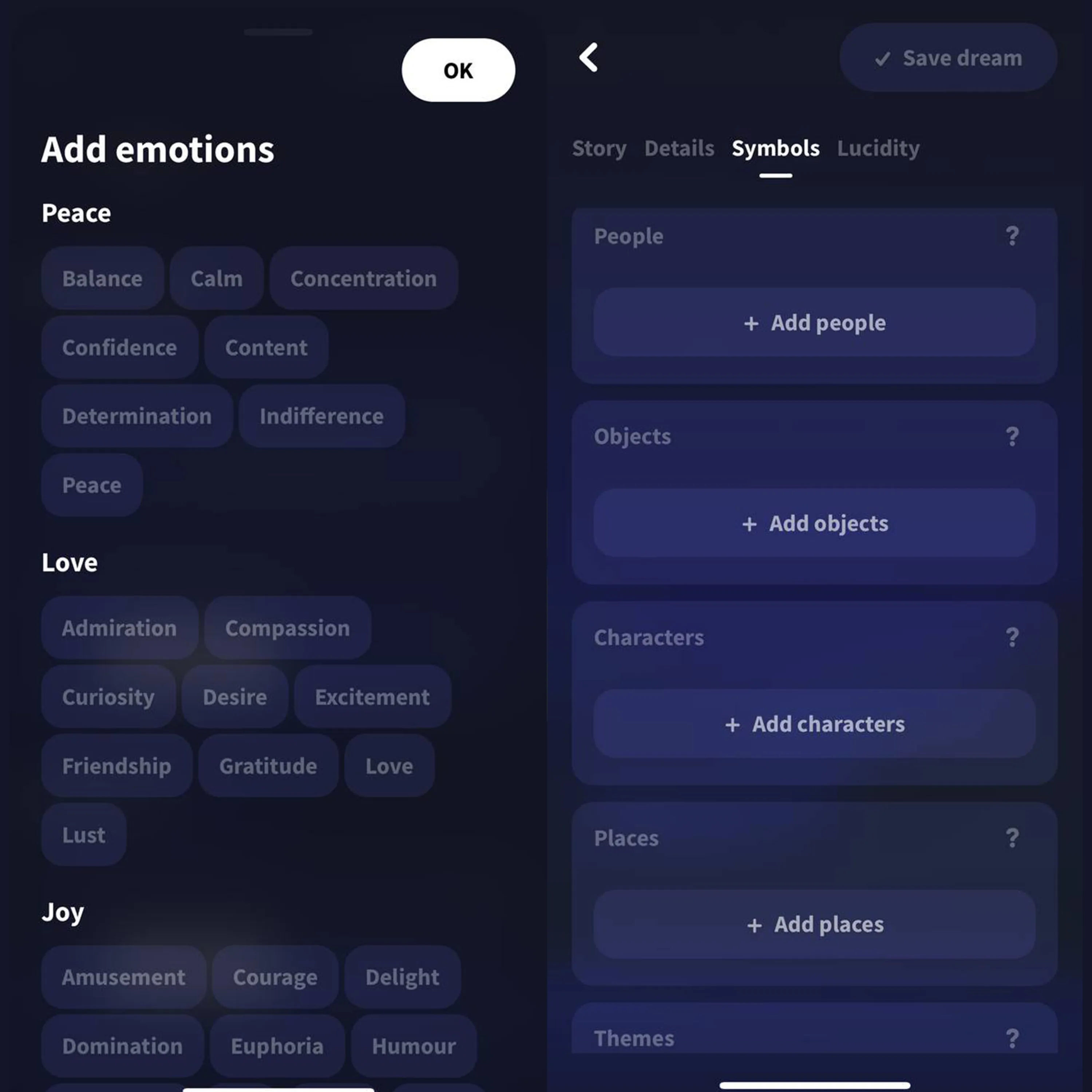
For each dream, identify the objects, environments, people/characters that show up. Ask yourself, what do these elements mean to you personally? What kind of associations do you have with them? Try to think outside the box instead of trying to understand it literally. For example, If you dream of an old friend, think about who you were in that time period of your life, not just about that person in particular.
Keywords#
When you are not able to record details of the dream, jot down some key words on a sheet of paper that will help you remember the dream later on. When you have time, you can fill in the narrative of the story in as much details as you can remember from the keywords.
Emotions#
Try to capture emotions, not just plot points. Get in the habit of noting how your dream-self felt in any given situation. Emotions can sometimes reveal more about the dream than the narrative. Also, record how you felt when you woke up.
Quality#
How long and detailed was your dream? Were you lucid? Was is a dream or a nightmare? Did you feel rested when you woke up? These are good things to note in your dream journal.
Read back on old dreams#
The practice of dream journaling is not just about writing down your dreams. It’s also about reading them again. Every now and then, you should go back and read your previous entries in your journal. If you feel comfortable with it, you can even share your dreams with someone you trust. That last part does more than you’d expect: when researchers had pairs discuss one person’s dream, the listener’s empathy toward the dreamer rose measurably.[4] Sharing a dream is unusually good at making someone feel close to you. Saying them out loud or even just reading them again will help you train your dream memory. It may also unveil some other elements you forgot or reveal some insights to understand your dream. Doing this regularly will improve your dream recall, therefore it’s a very good thing to do when you start dream journaling, and you still don’t remember much from your dreams. It is also a good habit to look back on dreams and identify moments where you should have become lucid, or realized it was a dream!
Use the Oniri features#
Use the Oniri mobile app for a seamless, organized dream journal! There is also a voice recording feature for days when you are too tired to write it out.
Considering that nearly one-third of our life is passed in a state of slumber, overlooking dreams would mean dismissing a sizable chunk of our existence that is rich in imagery and insights.Dreaming is an inherently subjective and singular experience. This means that the same dream symbol or image can mean different things to different people. It’s important to remember that dreams arise spontaneously from within us and there is no common dream dictionary that applies to everyone. Only the dreamer knows what a dream or its metaphors might mean to you. With this kind of self-inquiry, one dream can have many layers of meaning and can unfold over a period of time.
Benefits of recording your dreams#
Dream journaling over an extended period of time can reveal patterns, through recurrent dreams or the repeated appearance of important details in your waking life, and the more familiar your mind becomes with these patterns, the more awareness it might begin to have in wielding them while asleep. Repeated imagery, or dream symbols can be analyzed to better understand your subconscious and dream content. Dream journaling can also be a way to break a creative block. Check out this article that goes into more details about Why you should remember your dreams (oniri.io) .



Sources & References
This article was written based on published research, peer-reviewed studies, and trusted books. Check out the following sources to go further.
[1]Effect of encouragement on dream recall
Halliday, G. · 1992
Dreaming, 2(1)
[2]The effect of dream report collection and dream incorporation on memory consolidation during sleep
Schoch, S. F., Cordi, M. J., Schredl, M., & Rasch, B. · 2019
Journal of Sleep Research, 28(1)
[3]Recalling and forgetting dreams: theta and alpha oscillations during sleep predict subsequent dream recall
Marzano, C., et al. · 2011
Journal of Neuroscience, 31(18)
[4]Testing the empathy theory of dreaming: the relationships between dream sharing and trait and state empathy
Blagrove, M., et al. · 2019
Frontiers in Psychology, 10

Written by
Founder of Oniri
Jean-Baptiste founded Oniri and researches dreams, lucid dreams, creativity, and AI. He collaborates with the Sleep and Cognition Neuroimaging Laboratory in Geneva and is invested in different studies about lucid dreams and the intersection of dreams and AI, including a paper in the Journal of Sleep Research on cathartic dreams.
Share this article