Most Common Dreams and What They Mean
Oneirology, the study of dreams and their interpretations can be complicated. There is no scientific evidence of a universal meaning to dreams despite research suggesting that there are common dream themes between people. But what are those most common dreams? What do they mean? This article is all about the most common dreams and what they mean! Let's find out -
How common are the common dreams?#
Before the meanings, the numbers. Researchers handed a 55-item questionnaire to 1,181 first-year students across three Canadian universities and asked which themes they had ever dreamed.[1] The result is the closest thing we have to a ranking:
| Dream theme | Have dreamed it at least once |
|---|---|
| Being chased or pursued, not physically injured | 81.5% |
| Sexual experiences | 76.5% |
| Falling | 73.8% |
| School, teachers, studying | 67.1% |
| Arriving too late, missing a train | 59.5% |
| Being on the verge of falling | 57.7% |
| A person now alive as dead | 54.1% |
| Trying again and again to do something | 53.5% |
| Flying or soaring through the air | 48.3% |
| Vividly sensing a presence in the room | 48.3% |
| Failing an examination | 45.0% |
| Being nude | 32.6% |
| Your teeth falling out | 18.8% |
Two things stand out. Being chased tops the list by a distance, and it's also the theme people most often name as their earliest remembered dream. And teeth, the dream everyone talks about, sits near the bottom at 38th out of 55 themes. Other samples put it higher, so treat any single figure as an estimate rather than a fact, but the ranking itself is remarkably stable: a separate German study using the same questionnaire found the relative order of themes held almost perfectly.[2]
That stability is the interesting part. These aren't random. Something about being human keeps producing the same short list.
Teeth Falling Out#
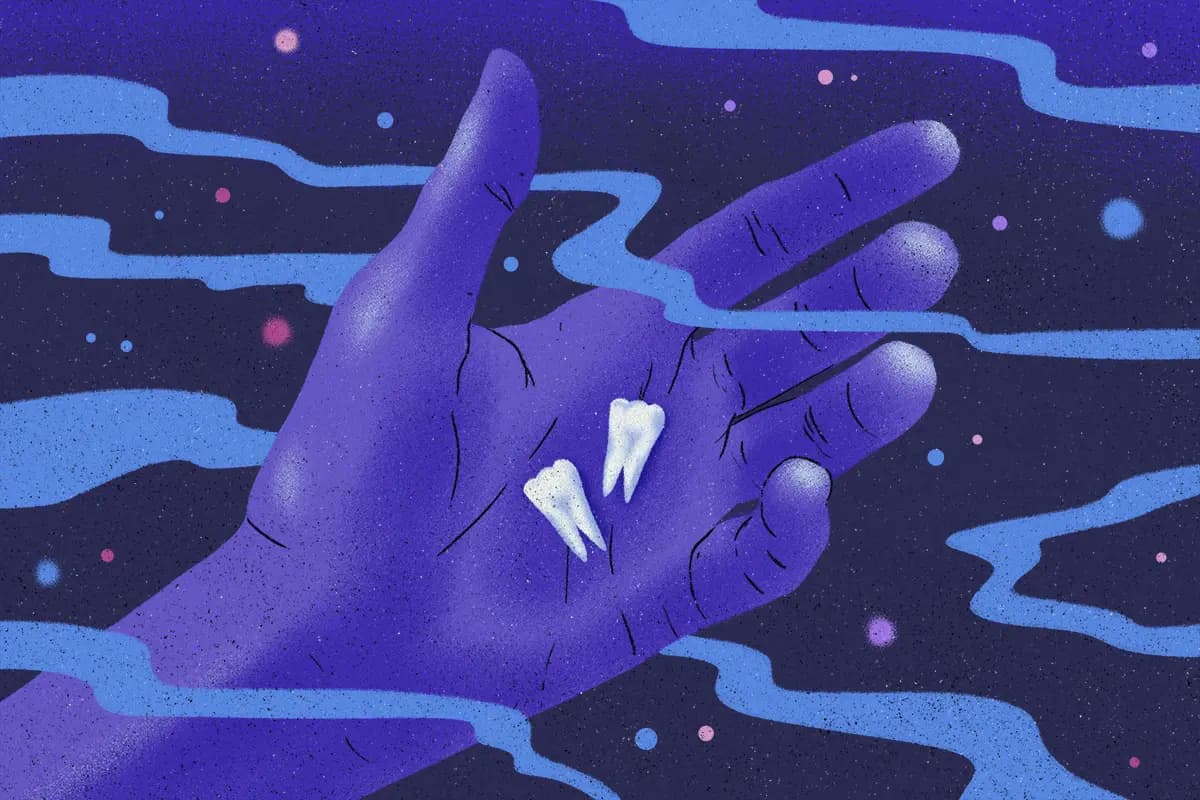
Typically, these dreams stem from a fear of rejection, embarrassment, or feeling unattractive. When you miss your teeth, you will find it more difficult to talk. It might be highlighting some difficulty communicating with someone or expressing yourself in some way. It can also relate to a sense of powerlessness as teeth are used to bite, tear and chew.
Dream About Teeth Falling Out: What Does it Mean?
Being chased#
This dream could suggest that you have a tendency to run away from issues rather than tackle them. This can be a recurring dream until you find the issue and resolve it in your waking life.
Flying#
Dreaming that you are flying can be a very fun and freeing experience. Dreaming of being able to fly in your dream can be interpreted in many ways. If you are having trouble flying it could represent an area in life where you are being held back.
Worth knowing: flying is common to have but rare to have often. Nearly half of people report at least one flying dream in their life, yet when a researcher combed through his own series of 6,701 recorded dreams, unaided flying showed up in just 1.72% of them.[3] The way of flying varied enormously from dream to dream, too: body position, what set it off, whether anyone else could see. So if you've had two flying dreams in a decade, that's normal.
Falling#
Falling is one of the most common dreams! To dream that you are falling into the water may suggest that you have very strong feelings for someone. Falling dreams may also be a result of myoclonic jerks. A myoclonic or hypnic jerk is a muscle twitch that occurs as you are falling asleep and is many times accompanied by a falling dream sensation.
Dreaming of snakes#
Snake dreams have long been discussed by ancient dream experts like Artemideros and even psychoanalysts such as Carl Jung. The meaning of snakes in a dream can vary significantly for people, depending on how they feel about snakes and what role snakes may play in their life. Everyone has different views on snakes. It could be a positive or negative symbol. Snakes could be linked to the feeling of being constricted. More positive meanings include the feeling of change or rebirth due to the shedding of skin. There is an idea from certain cultures that snake venom is transformative.
Types of Dreams#
Do you ever experience any of these common dreams? Rest easy knowing it is normal. If you're curious to go deeper, Oniri can help you understand what your dreams mean by decoding their symbols and recurring themes. There are also a few different types of dreams. Let’s explore them.
Recurring dreams#
Recurring dreams refer to a dream someone has over and over again. Although they're a normal part of sleep for most people, they can be stressful, and they lean negative far more often than not.
Research using self-determination theory gives the clearest account of why. Across a cross-sectional study of 200 people's recurring dreams and a three-day diary study of 110 people's daily dreams, what predicted negative dream themes was need frustration: feeling short on autonomy, competence or connection to others, either as a lasting state or just on a given day. People in that position reported darker dreams and also interpreted their dreams more negatively. Need satisfaction had a smaller effect in the other direction.[4]
So a recurring dream is less a message than a readout. Something in your life isn't getting enough room, and it keeps showing up at night until it does. Recurring dreams may be exactly the same every time or only recycle the same scenarios or fears.
Daydreams#
We spend around 30% to 50% of our time in daydreams. Daydreaming is when our conscious awareness drifts away from daily life, and into an internal exploration. Slow brain waves, similar to those of deep sleep, appear in the brain right before daydreaming. There are both positive and negative effects of daydreaming.
Nightmares#
Nightmares are frightening dreams that involve intense negative emotions. In children, nightmares are a regular stage of the development process. Most people have nightmares occasionally, but for others, they frequently recur, disrupting sleep and negatively impacting their waking life.
Lucid dreams#
During a lucid dream, you become consciously aware inside the dream, realize you are dreaming and, in some cases, can then control the dream. Lucid dreaming therapy has been known to treat nightmares. There are many useful ways to use lucid dreaming, and it is also a very fun and unique dream experience. Lucid dreaming is a learnable skill. Although some people have lucid dreams naturally and spontaneously, anyone can teach themselves to have more lucid dreams.
Learn more about lucid dreaming!
False awakenings#
This is a dream state characterized by the perception of waking up in a familiar place, starting a normal morning routine, and then realizing that you’re dreaming. Find our previous article about false awakenings here What are false awakenings and how to handle them (oniri.io)
Conclusion#
So these were the most common dreams and their meanings! There is no end to unique dreams and different meanings. Every person dreams based on their own life experience or psychologies. Dream meanings are also subjective to each person! But these most common dreams are dreamed by almost every person out there!



Sources & References
This article was written based on published research, peer-reviewed studies, and trusted books. Check out the following sources to go further.
[1]The typical dreams of Canadian university students
Nielsen, T. A., et al. · 2003
Dreaming, 13(4)
[2]Typical dreams: stability and gender differences
Schredl, M., et al. · 2004
The Journal of Psychology, 138(6)
[3]Frequency and nature of flying dreams in a long dream series
Schredl, M. · 2011
International Journal of Dream Research, 4(1)
[4]Linking psychological need experiences to daily and recurring dreams
Weinstein, N., Campbell, R., & Vansteenkiste, M. · 2018
Motivation and Emotion, 42(1)
[5]Studying dream content using the archive and search engine on DreamBank.net
Domhoff, G. W., & Schneider, A. · 2008
Consciousness and Cognition, 17(4)

Written by
Host of the Dream World Podcast
Amina has been lucid dreaming since childhood. She studied psychology at Emory University and is a member of the International Association for the Study of Dreams. In 2020 she founded the Dream World Podcast, now a community and a three-month course on lucid dreaming and consciousness.
Share this article