How to Interpret Your Dreams
Dream meanings are not universal#
If you had a dream and you are curious of what it could mean, try not to rely on generic dream dictionaries. There is no universal meaning to dreams, even common dreams such as being naked in public. One dream can mean something different to two different people. It is vital to understand that dreams are personal. That is why dream dictionaries and advice from other websites can be so confusing.
A dream dictionary written by someone else can kick-start metaphorical thinking by providing examples when we are stuck for ideas, or new to dream interpretation. However, ultimately only the dreamer knows the true meaning to their own dream. Interpreting your dreams takes patience, practice, and an open mind.
Personal dream language#
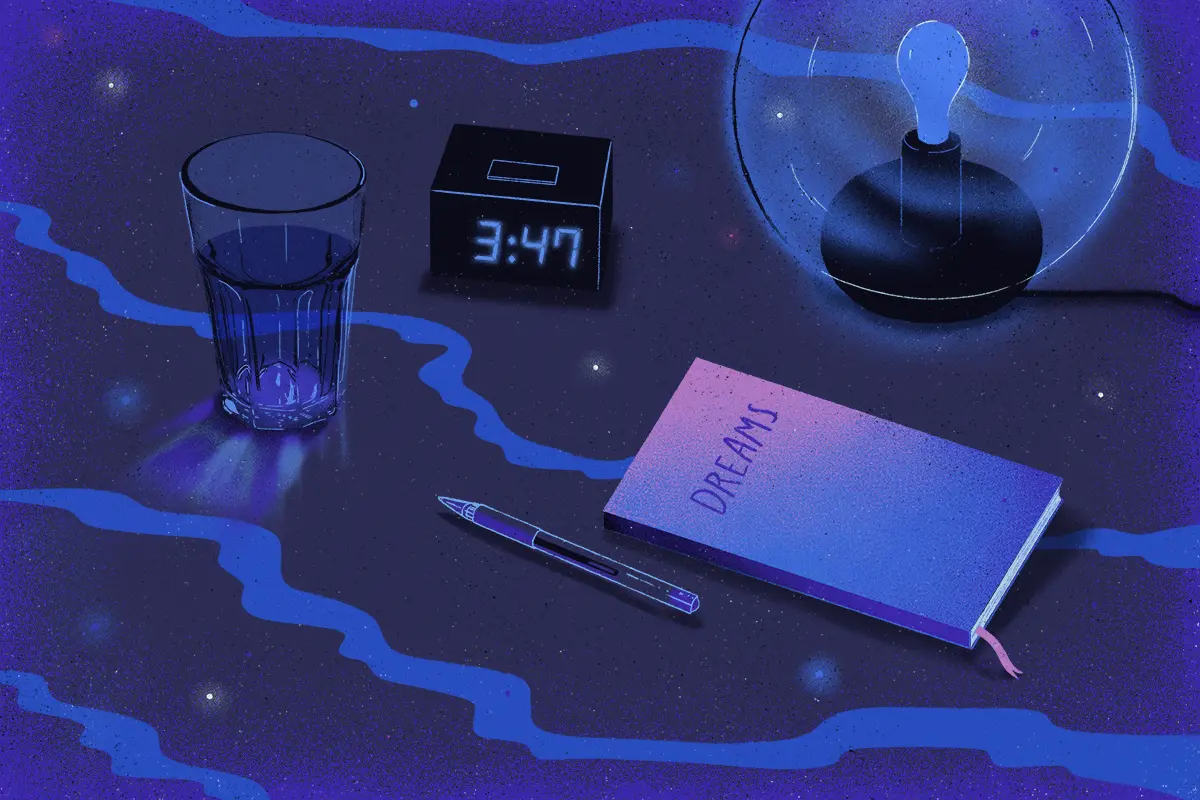
Learning to interpret your dreams is much like learning a whole new language. However, do not let that intimidate you. It is a language that your subconscious mind uses to communicate with you, known as your personal dream language. The more dreams you record, the more data you have for understanding your dreams. Be consistent with your dream journal, even if the dreams seem insignificant at first.
This is not just encouragement to be diligent. Dream researchers who study long individual dream series find that meaning emerges from the series, not the single dream: what recurs, what shifts, who keeps appearing.[1] A single dream is one sentence in a language you're still learning. Twenty gives you grammar. There's also a well-documented link between waking life and dream content, strong enough that the amount of time you spend on an activity roughly predicts how often it turns up at night, which gives you something concrete to check your interpretations against.[2]
Symbols#
A good starting place for dream analysis is identifying common symbols and understanding what they might mean for you specifically. Describe the people, objects, environments, actions and characters in your dream as best as you can. Ask yourself:
•What was the symbol or object doing in your dream?
•What did it look like?
•Where was it?
•How did you feel about it while you were dreaming?
•How do you feel now when you think of it?
Emotions#
Usually, it is not just the symbols in the dream that can tell you what it means. It is a combination of symbols, feelings and context. It’s important to consider the feelings and emotions that are present in our dreams too. What was the overall energy of the dream? What is this bringing up emotionally?
Find more connections#
Try to think of anything that comes to mind when analyzing the components of the dream. What is the first thing that comes to mind when you think of this symbol? Be descriptive. Sometimes it helps to describe an object as if you were explaining it to an alien who has never seen it before. This can help to bring up associations. Think about how the dream symbols may relate to your waking life. It may not be obvious at first. Try to think if there is anyone or any context that matches your free associative descriptions.
Dream sharing#
Describe your dream to someone close to you, ideally someone who knows you well. There is decent evidence this works better than solo reflection: in a controlled comparison, considering a recent dream in a structured group discussion produced significantly more personal insight than considering a recent waking event the same way.[3] And it goes both directions, because listening to someone's dream measurably increases the listener's empathy toward them.[4]
Sometimes, it’s about how you describe a dream more than the dream itself. As you tell someone else about your dream, try to become aware of how you describe specific symbols that may not be as clear at first. They may be able to give you feedback about specific words you used or facial expressions you made, which could also add to the dream interpretation.
Once you learn your own dream language, deciphering and decoding your dreams becomes easier. Dreams are not always literal. They can be metaphorical or written in a sort of code. This is why keeping a dream journal is so important. It allows you to pick up on patterns, and piece together the pieces of your own personal dream language.



Lähteet ja viitteet
Tämä artikkeli perustuu julkaistuun tutkimukseen, vertaisarvioituihin tutkimuksiin ja luotettaviin kirjoihin. Katso alla olevat lähteet, jos haluat syventyä aiheeseen.
[1]Studying dream content using the archive and search engine on DreamBank.net
Domhoff, G. W., & Schneider, A. · 2008
Consciousness and Cognition, 17(4)
[2]Continuity between waking activities and dream activities
Schredl, M., & Hofmann, F. · 2003
Consciousness and Cognition, 12(2)
[3]Comparing personal insight gains due to consideration of a recent dream and consideration of a recent event
Edwards, C. L., et al. · 2015
Frontiers in Psychology, 6
[4]Testing the empathy theory of dreaming: the relationships between dream sharing and trait and state empathy
Blagrove, M., et al. · 2019
Frontiers in Psychology, 10

Written by
Founder of Oniri
Jean-Baptiste founded Oniri and researches dreams, lucid dreams, creativity, and AI. He collaborates with the Sleep and Cognition Neuroimaging Laboratory in Geneva and is invested in different studies about lucid dreams and the intersection of dreams and AI, including a paper in the Journal of Sleep Research on cathartic dreams.
Share this article