Sleep Paralysis Demon: What It Is and What to Do
Det viktigaste i korthet
- A sleep paralysis demon is a hallucination that happens when you wake up while your body is still paralysed by REM sleep, so part of a dream plays out in your real bedroom.
- Across 35 studies, about 8% of the general population and 28% of students had experienced sleep paralysis at least once.
- Most sleep paralysis episodes are over within five minutes, and the figure people see during them cannot hurt them.
- In a study comparing Denmark and Egypt, Egyptians with sleep paralysis had three times as many episodes, and those who believed a supernatural being caused it felt more fear and stayed paralysed longer.
- MR therapy, a four-step method that combines calm reassurance, focused attention and muscle relaxation, halved the number of days with sleep paralysis in a small pilot study.
Waking up unable to move, with the feeling that someone else is in the room, is far more common than most people think. More than one student in four has had sleep paralysis at least once.[1] The figure that sometimes comes with it, a dark shape at the foot of the bed or a weight on the chest, is what people call a sleep paralysis demon, and people have described it in much the same way since at least the 1600s. It feels real, but it's a dream that keeps running for a minute or two after the mind wakes up, and it can't hurt you. Here's why it looks the way it does, and what to do when it comes back.
What is a sleep paralysis demon?#
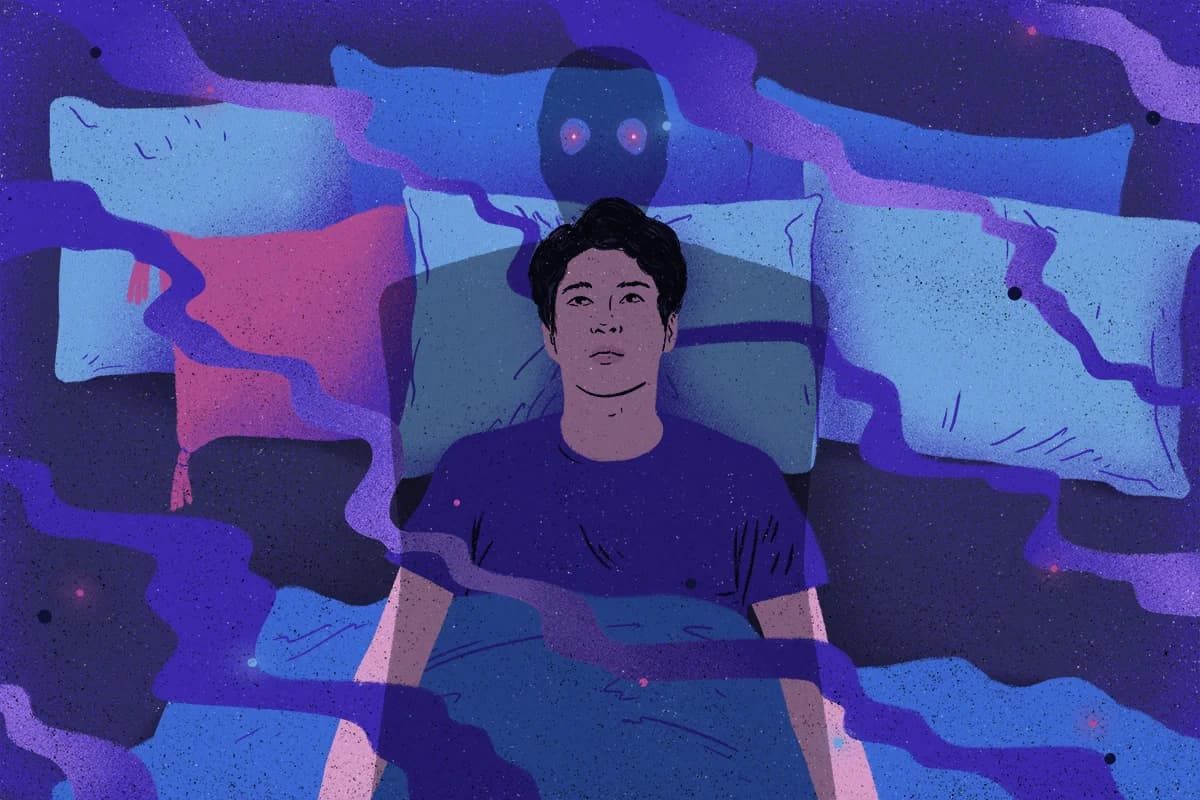
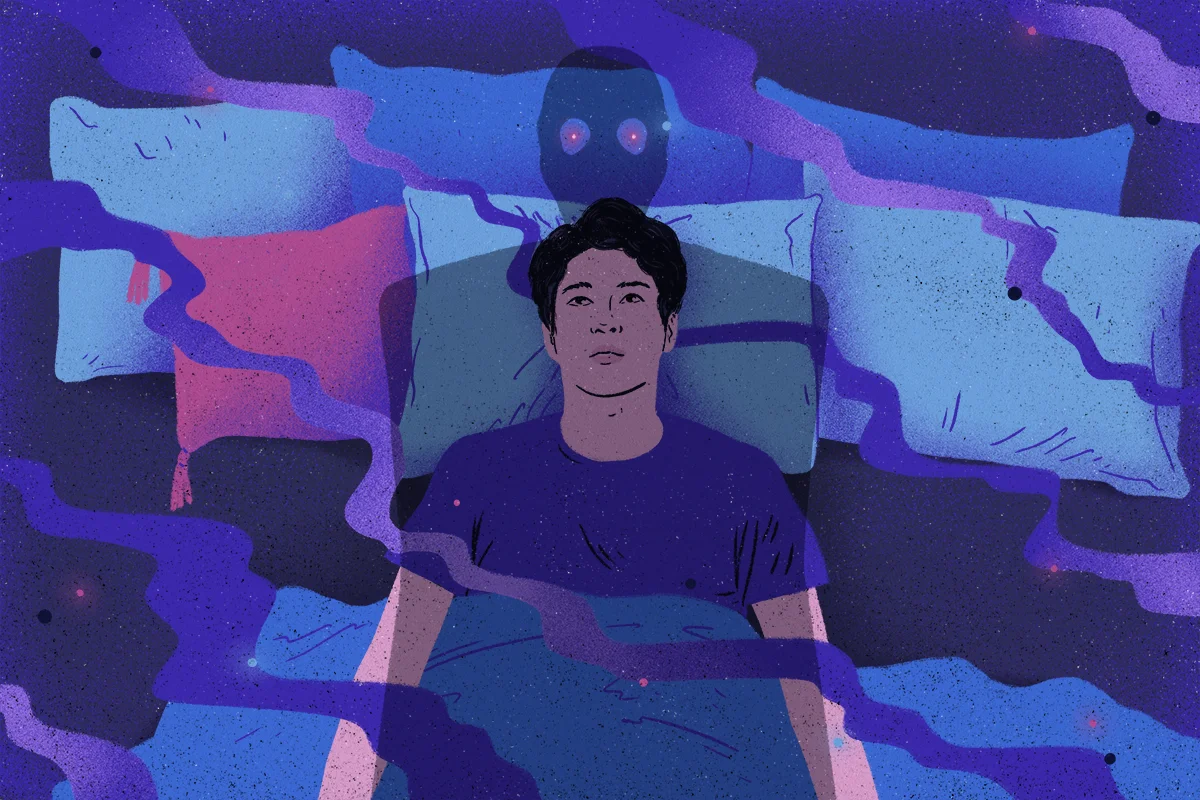
A sleep paralysis demon is a hallucination you have while you're awake but still paralysed by REM sleep, the stage of the night when most vivid dreams happen. During REM our brains switch off almost every muscle, so we don't act out our dreams (you don't punch the wall when you dream about a fight). Sleep paralysis is what happens when you wake up, or start to fall asleep, while that switch is still on. You can see the room and think clearly, but you can't move or speak, and the dream hasn't quite finished.[2]
The demon is a piece of that unfinished dream, projected onto the room you can actually see. Most episodes come at the end of sleep, when we come out of our longest stretches of dreaming, and in one Italian study 84% of people had theirs as they woke up.[2] The ones that come as you drift off belong to the same family as hypnagogic hallucinations, the flashes of images and voices many of us get at the edge of sleep. If you want the biology of the stage itself, what REM sleep is for covers it.
It's common, too, far more than people admit over breakfast. Across 35 studies, about 8% of the general population had had at least one episode of sleep paralysis, and the rate reached 28% among students and 32% among psychiatric patients.[1] Not everyone who has it sees a demon, but almost everyone feels something.
What do you see during sleep paralysis?#
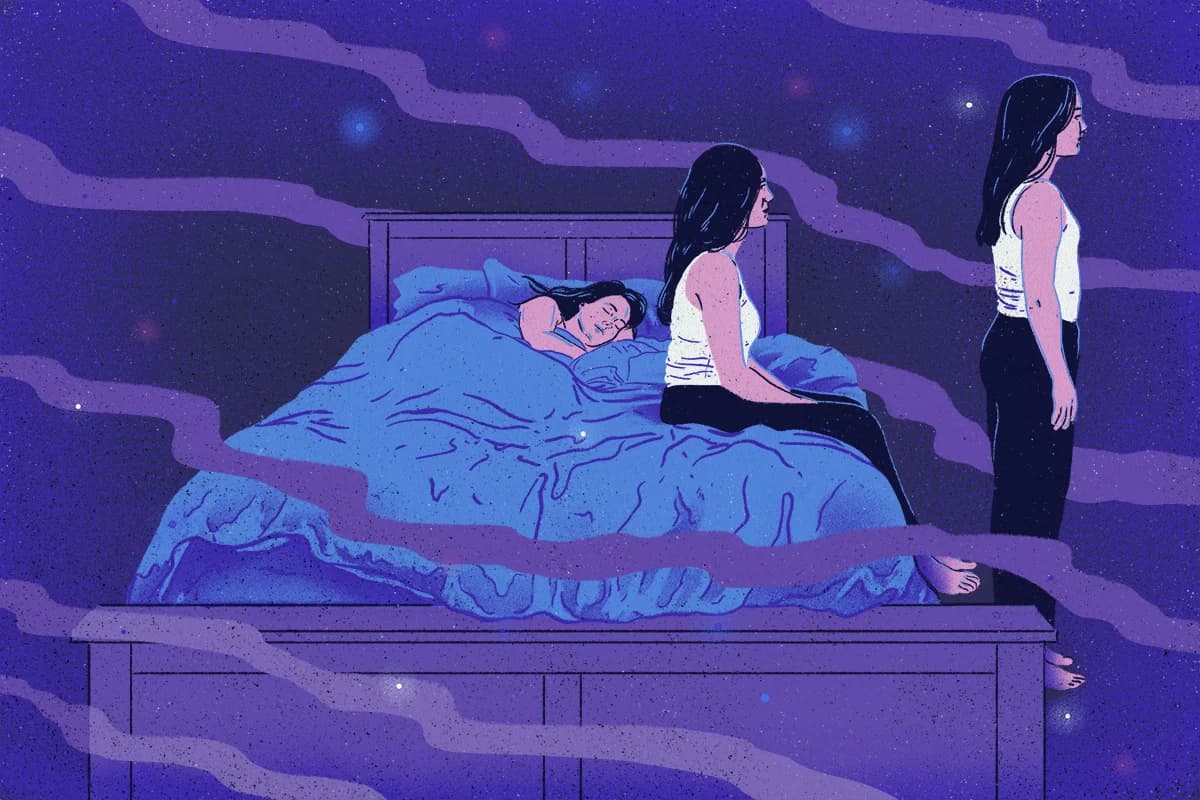
If you've had an episode, you already know that "a shadow" doesn't cover it. Researchers sort what people go through into three families. The first is the intruder, a sense of an evil presence in the room, often with footsteps, whispers or a figure. The second is the incubus, a weight on your chest that makes it hard to breathe, sometimes with pain. And the third is a floating or spinning feeling that can turn into leaving your body.[3]
Fear is the one thing nearly everyone shares, and in a group of 67 Italians with sleep paralysis, 94% were frightened during their episodes, more than half said they felt a lot of fear, and 42% were afraid they might die.[2] Seeing something was less common than feeling it, though, and more of them felt a touch or something holding them down than saw anything at all.
What people experience during sleep paralysis
Share of sleepers who had each experience at least once
- Felt touched, grabbed or held down: 69%
- Sensed someone they couldn't see: 55%
- Saw something: 37%
- Saw a shadow: 25%
- Heard something: 22%
- Felt they left their body: 16%
- Felt a creature sitting on their chest: 9%
Source: Jalal et al., 2021[2]. 67 people with sleep paralysis in Italy.
The presence you can't see is often the worst part, because your mind fills it in with whatever it fears most. One modern sufferer described it in a way that most people who've been there will recognise, as a body in the bed that stayed just out of view.
I imagined that somebody was laying in bed with me, but I couldn't see them because I was struggling to turn over but couldn't move.
Why does everyone see the same demon?#
When the fear wears off, what unsettles most people is how familiar their demon sounds once they look it up. So why do strangers on three continents describe the same thing, a dark human shape standing in the doorway or at the foot of the bed, sometimes coming closer? Part of the answer is the setting, which is the same for everyone. You're lying in a dark room with your eyes half open, your brain is still producing a dream, and you're scared. In that state, a coat on a door easily turns into a person. Fear and a distorted sense of your own body might be enough to trigger a shadowy human figure, and the figure then feeds the fear.[2]
The neuroscientist Baland Jalal and his colleague V. S. Ramachandran have suggested a reason it's so often human. While you're paralysed, your brain gets almost no signals back from your body. The part of the brain that keeps a map of where your body is may lose track of it. Their idea is that this map gets projected outward, so your brain sees a copy of your own body as "someone else" in the room.[5] It fits an odd finding they point to, in which stimulating that same brain area with an electrical current produced the feeling of a shadow-like person copying the body's posture.[5]
It's a hypothesis, and nobody has yet tested it on people in the middle of an episode. But it explains why the demon is so rarely anything truly strange, and why it tends to be roughly your size, standing where you'd expect a person to stand.
The Old Hag, the jinn and other names for the same demon#
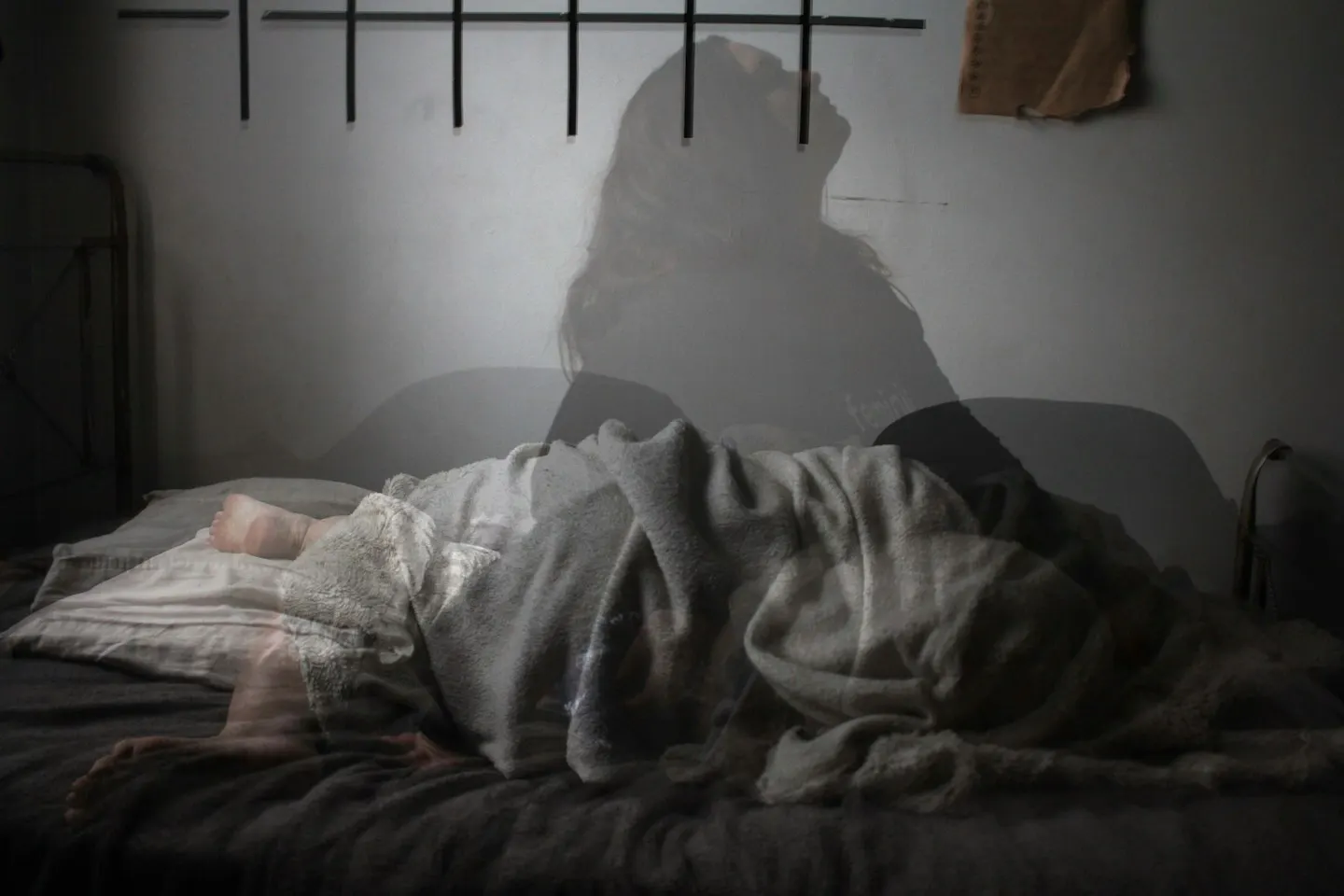
Cultures all over the world have their own name for this visitor. In Newfoundland it's the Old Hag, and on the Caribbean island of St Lucia it's the Kokma, the spirit of an unbaptised baby that jumps on sleepers' chests.[4] People in China call it "ghost oppression", in Japan it's kanashibari, in Egypt it's an attack by a jinn, and in Turkey it's the Karabasan. In the United States, some people who wake up paralysed with figures around the bed remember it as an alien abduction.[2]
In the Abruzzo region of Italy the culprit is the Pandafeche, which people describe as an evil witch, a ghost or a black cat-like creature. Some there still keep it away with a broom, and 18% of the sufferers in one study said you should stand it bottom-up by the bedroom door.[2] The first medical description is much older. In 1664 a Dutch physician wrote up the case of a woman who, as she settled down to sleep at night, found she couldn't move.[4]
Sometimes she believed the devil lay upon her and held her down, sometimes that she was choaked [sic] by a great dog or thief lying upon her breast.
He called her illness "Incubus or the Night-Mare", and a century later Henry Fuseli painted it. In The Nightmare (1781), a young woman lies limp across her bed while a small demon squats on her stomach and stares out at you. One paper calls the painting "literally the clinical presentation of sleep paralysis".[4]
Does believing in the demon make it worse?#
If you grew up hearing that something visits people in their sleep, the explanation you reach for at 4am matters more than you'd think. When researchers compared the general population of Denmark and Egypt, 44% of Egyptians had had sleep paralysis against 25% of Danes. The Egyptians who had it went through three times as many episodes in their lives, stayed paralysed longer and were far more afraid of dying during them.[6]
Average number of episodes in a lifetime
Among people who had sleep paralysis at least once
- Denmark: 6
- Egypt: 19
Source: Jalal and Hinton, 2013[6]. 58 people in Denmark and 143 in Egypt.
Within Egypt, the people who believed a supernatural being had caused their sleep paralysis felt more fear during it and stayed paralysed longer.[6] That's a link and not proof, and it could run both ways, since a longer and more frightening episode would make anyone more ready to believe something was in the room. But it fits what Jalal describes as a loop of panic. Fear makes your heart race and your breathing speed up, which makes the episode worse, longer and more crowded with frightening images. And that leaves you more afraid of the next one.[7]
Is the sleep paralysis demon dangerous?#
No, whatever it looks like and whatever it seems to do, the demon can't hurt you, and the paralysis always wears off. In the Italian study, 18% of people said an episode lasted less than a minute, 61% between one and five minutes, and 21% longer than that (fear makes a minute feel very long).[2] Most episodes happen in people who don't have narcolepsy or any other sleep disorder, and they aren't linked to any serious illness.[2]
It is worth seeing a doctor in two cases. One is when episodes come often enough that you dread going to bed, or your sleep is suffering because of them. The other is when sleep paralysis comes with heavy sleepiness during the day or sudden muscle weakness when you laugh. Those are signs of narcolepsy, a sleep disorder in which sleep paralysis is common.[8] For everyone else, the best way to have fewer episodes is the usual advice (sleep enough, at regular hours), and the sleep hygiene habits that matter most are a good place to start.
How to make a sleep paralysis demon go away, in 4 steps#
The method with the best evidence so far is MR therapy, short for meditation-relaxation, which Jalal designed for the moment itself. It has four steps, and it works best if you practise them a few times while you're awake and lying on your back, so they feel familiar when the paralysis comes.[7]
1. Tell yourself what's happening#
As soon as you realise you can't move, tell yourself that this is sleep paralysis, that it's common and harmless and that it will end soon. The figure is a dream, nothing more. Keep your eyes closed and stay still.[7]
2. Let the fear go past#
Remind yourself that there's nothing to be afraid of, and that fear and worry only make the episode worse and can make it last longer.[7] You don't have to feel calm yet, and it's enough to stop feeding the panic.
3. Focus on something you love#
Turn your attention inward to one warm thing, like a memory of someone you love, a song or a prayer, and stay with everything good about it. When your attention drifts back to the figure or the weight on your chest, bring it back to the memory.[7]
4. Relax your muscles and don't try to move#
Let your body go loose while you focus, without tensing anything or trying to control your breathing, and don't try to move at all.[7] Struggling against the paralysis is what most people do by instinct, so this is the step that takes the most rehearsal.
One of the people Jalal describes trying it is Joe, a man in his early thirties who had been through all kinds of horrors during his episodes. The next time the paralysis came, he felt a heavy weight on his chest. He closed his eyes, relaxed and kept telling himself it was "caused by the brain, and therefore should not be feared". Then, feeling calm enough, he opened his eyes to face whatever was there and saw three helpless, innocent-looking young boys.[7]
Joe's story is a single case, but the first trial is encouraging. In six people with narcolepsy who used MR therapy for eight weeks, the number of days with sleep paralysis halved and the number of episodes dropped by 54%. A group who only practised deep breathing saw no change.[8] Fear during the episodes that remained didn't drop significantly, and six people is a very small study, so take it as a promising start.
People find other ways out too, and how to stop sleep paralysis goes through them along with what to change in your evenings. Whichever you choose, rehearse it while you're awake, because panic makes it hard to remember anything new in the moment.
Can sleep paralysis turn into a lucid dream?#
Once the fear is gone, some people find that the same half-awake state can go somewhere else entirely. In a survey of almost 2,000 people, those who had sleep paralysis more often also had slightly more lucid dreams (dreams where you know you're dreaming). The link was strongest for the floating, out-of-body kind of episode.[3] Some people report sliding from sleep paralysis into a lucid-dream-like state, or feeling themselves leave their body, and others go from a lucid dream straight into paralysis.[3,7]
Lucid dreamers use this on purpose, and the wake-initiated techniques aim to carry your awareness from waking straight into a dream, and paralysis is often part of the way in. One old practice is the rope method. You lie still and imagine pulling yourself up a rope hand over hand (without moving your real arms) until you feel yourself lift into the dream. Nobody has studied it, but it's harmless to try, and so is lucid dreaming itself for most people (the details are in can lucid dreaming harm you). If you'd like a guide, Oniri's lucid dreaming app walks you through the techniques one night at a time.
Jonah, who was in his late teens and had terrifying episodes three to five times a week, used MR therapy for eight weeks. By the end his fear of sleep paralysis had gone, and he said he felt "more grounded and less freaked out".[7]
When the fear is gone, you learn to appreciate it.
The demon has had a hundred names, from the Old Hag to the Pandafeche. The one that helps you most is the least exciting (a dream that hasn't finished yet). You won't stop having sleep paralysis overnight. But once you know what's in the room, you can close your eyes, think of someone you love and wait for your body to catch up. And on a good night, you might even get curious about where that half-open door leads.
Vanliga frågor
Why is my sleep paralysis demon someone I know?
Your sleep paralysis demon can look like someone you know because it's built from your own memories, like any other dream. In one Italian study, 13% of people with sleep paralysis saw a person during an episode, including a girlfriend, a sister and a friend. A familiar face doesn't mean that person wishes you harm or that something is wrong between you. Your dreaming brain simply uses the faces it knows best.
Can sleep paralysis demons talk to you or touch you?
Sleep paralysis demons can seem to do both, but nothing is actually there. Hearing footsteps, whispers or a voice calling your name is common during sleep paralysis, and so is feeling pressure on your chest, a hand on you or someone holding you down. In one Italian study, 69% of sufferers felt touched or held. It's all made by your dreaming brain, and it stops when the episode ends.
Can you have sleep paralysis without seeing a demon?
Yes, and many people do. Some wake up unable to move for a minute and see or hear nothing at all. In one Italian study, 78% of people with sleep paralysis had some kind of hallucination, but only 37% saw anything and 25% saw a shadow. The rest felt pressure, heard sounds or had a sense of floating, which are just as normal and just as harmless.
How long does sleep paralysis last?
Most episodes of sleep paralysis last between a few seconds and five minutes. In one Italian study, 18% of people said their paralysis lasted less than a minute, 61% between one and five minutes, and 21% longer. Fear makes the time feel much longer than it is. An episode always ends by itself, and staying calm keeps it from getting worse while it lasts.
What's the difference between a sleep paralysis demon and a night terror?
A sleep paralysis demon comes while you're awake and aware but still paralysed by dreaming sleep, and you remember it clearly afterwards. A night terror happens in deep sleep without dreams: the person screams, thrashes or sits up while still asleep, and usually remembers little or nothing in the morning. Night terrors are also much more common in children than in adults.



Källor och referenser
Den här artikeln bygger på publicerad forskning, peer review-granskade studier och pålitliga böcker. Kolla källorna nedan om du vill gräva djupare.
[1]Lifetime prevalence rates of sleep paralysis: a systematic review
Sharpless, B. A., & Barber, J. P. · 2011
Sleep Medicine Reviews, 15(5)
[2]Sleep paralysis in Italy: frequency, hallucinatory experiences, and other features
Jalal, B., Romanelli, A., & Hinton, D. E. · 2021
Transcultural Psychiatry, 58(3)
[3]Terror and bliss? Commonalities and distinctions between sleep paralysis, lucid dreaming, and their associations with waking life experiences
Denis, D., & Poerio, G. L. · 2017
Journal of Sleep Research, 26(1)
[4]Sleep paralysis and folklore
Cox, A. M. · 2015
JRSM Open, 6(7)
[5]Sleep paralysis, "the ghostly bedroom intruder" and out-of-body experiences: the role of mirror neurons
Jalal, B., & Ramachandran, V. S. · 2017
Frontiers in Human Neuroscience, 11
[6]Rates and characteristics of sleep paralysis in the general population of Denmark and Egypt
Jalal, B., & Hinton, D. E. · 2013
Culture, Medicine and Psychiatry, 37(3)
[7]How to make the ghosts in my bedroom disappear? Focused-attention meditation combined with muscle relaxation (MR therapy): a direct treatment intervention for sleep paralysis
Jalal, B. · 2016
Frontiers in Psychology, 7
[8]Meditation-relaxation (MR therapy) for sleep paralysis: a pilot study in patients with narcolepsy
Jalal, B., Moruzzi, L., Zangrandi, A., Filardi, M., Franceschini, C., Pizza, F., & Plazzi, G. · 2020
Frontiers in Neurology, 11

Written by
Founder of Oniri
Jean-Baptiste founded Oniri and researches dreams, lucid dreams, creativity, and AI. He collaborates with the Sleep and Cognition Neuroimaging Laboratory in Geneva and is invested in different studies about lucid dreams and the intersection of dreams and AI, including a paper in the Journal of Sleep Research on cathartic dreams.
Share this article