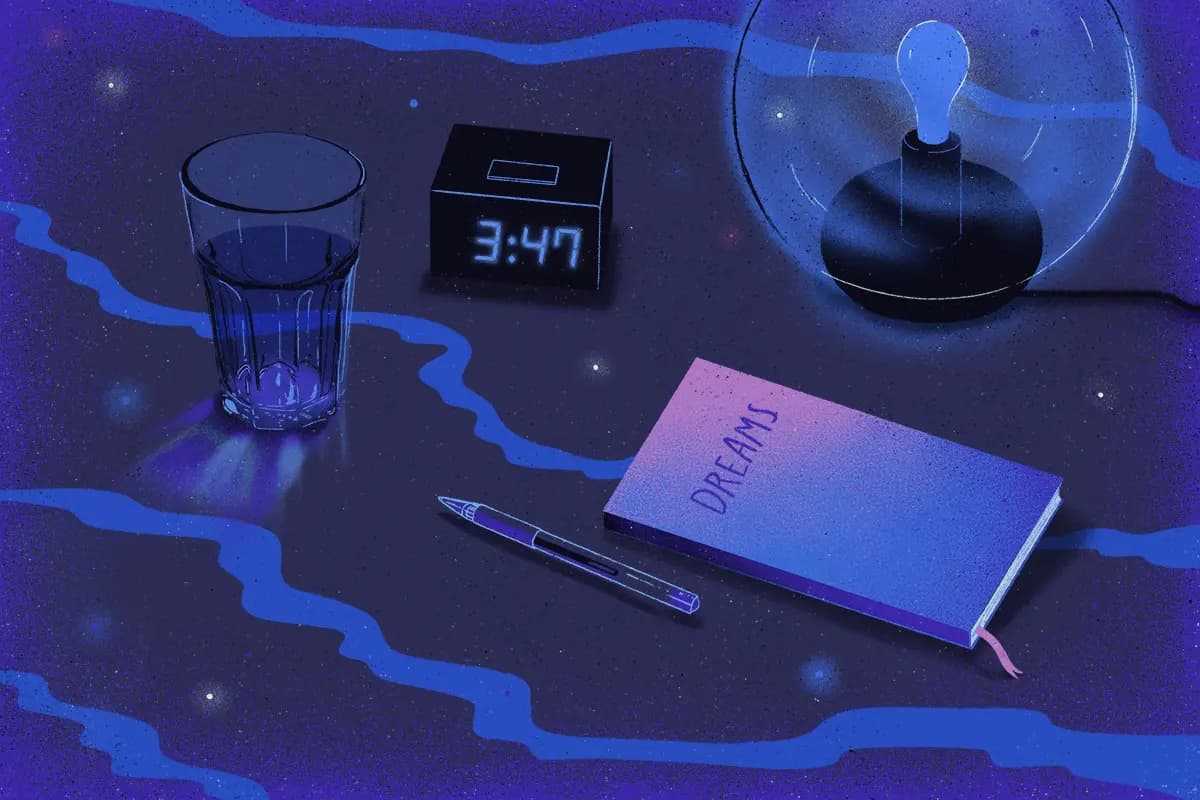
What Is a Dream Journal and How to Keep One
All of us know of someone who has a personal journal. It can be an empty paper book, a phone app or even a website. The concept is simply to write things into this journal on a daily, weekly, monthly or whatever cadence works for you. Some people write about their relationships, their work, the important things that happen to them and so on. The cliché type of personal journal entry would be something like “Dear journal, today was a great day, I …” As the name indicates, a personal journal is, well, personal. It’s usually not meant to be shared (even though some people might try to find your personal journal out of curiosity) and it is mostly a way to self-reflect, to re-read one’s past thoughts and to see how one has changed over the years.
A dream journal plays a similar role for your dreams. It is a way to write down your dreams when you wake up, to help you reflect upon them, remember them, understand them and so on. Lucid dreamers often use a dream journal to help them identify clues in their dreams, that they were in fact dreaming, thereby triggering a lucid dream.
Why keep a dream journal?#
There are many benefits to recording your dreams. When you keep a dream journal, you are training your brain to automatically remember more dreams. You are also increasing your chances of becoming lucid while dreaming.
The training part is real, and it starts absurdly early. In one study, 45 people who all reported zero dream recall in the previous month were split in two. One group was simply encouraged to remember their dreams; the other was only asked about them. By the next session, 68% of the encouraged group had recalled a dream, against 32% of the others.[1] Paying attention to your dreams is most of the technique.
That fits what larger surveys find: how well you remember your dreams tracks your attitude toward them. People who consider dreams worth thinking about remember more of them.[2] A journal is the most practical way to hold that attitude, because it asks the question every morning whether you feel like it or not. And the writing itself isn't passive: collecting dream reports has been shown to interact with overnight memory consolidation rather than merely documenting it.[3] You will be building a memory bank of awesome dream experiences that you would have never remembered if you weren't writing them down. Keeping a dream journal is foundational to any dream work practice. Read our article that goes into more detail on Why you should remember your dreams (oniri.io) .
Different kinds of dream journals#
Everyone is different when it comes to which dream journaling method they prefer. Many people even use a combination of various methods. Here is a list of the most common dream journal methods.
Pen & paper journal#
The old-fashioned way to keep a dream journal never fails. You can use a notebook, or a stack of sticky notes. Some people prefer this method because it feels natural to physically write out the dream using their hands. The writing motion helps stimulate their brain to remember more of the dream. The downside to this method is that sometimes it can be hard to write legibly in the dark.
Voice-recorder#
Using a recorder is a great way to document dreams and the emotions associated with telling the dream story. Some people use the default recorder on their phone. There are also apps that have voice-activated recorders. These are cool because they will be turned on and ready to pick up your voice recording as soon as you start speaking. The benefit to this method is that you can speak into the recorder without moving your body. Staying in the same body position helps to not wake up fully, so you can remember more of the dream.
Drawing/art#
Turn your dream journal into a wonderful set of drawings imported straight from your imagination. You can do this digitally, or through any artistic medium. It is also good to record dreams that are more abstract. Through art you can convey a feeling using color and energy without needing a solid storyline.
Dream journal apps#
There are mobile apps designed to combine all the above dream journaling methods. Dream journal apps such as Oniri, incorporate a voice recording feature, and AI generated images to represent your dream. With a mobile database of all your dreams, you can easily navigate your dream journal and read through old dreams. You cam also organize your dreams by highlighting people, objects, environments, actions, themes, and emotions. One downside of this method is that the blue light in your phone may supress melatonin and immediately start to wake you up, but for many people that is outweighed by the benefits of this method.
Conclusion#
There is no one best way to record your dreams. What is important is that you record them somehow. Find what works best for YOU! In the past few years, we have seen the rise of apps to improve the practice of dream journaling. There are also many things you can do to make your dream journal stronger. Read our article on How to keep a good dream journal (oniri.io). We hope this little guide helped you to understand what a dream journal is and how to use it!



Kilder og referanser
Denne artikkelen bygger på publisert forskning, fagfellevurderte studier og pålitelige bøker. Ta en titt på kildene under hvis du vil gå dypere.
[1]Effect of encouragement on dream recall
Halliday, G. · 1992
Dreaming, 2(1)
[2]Dream recall frequency, attitude toward dreams, and the Big Five personality factors
Schredl, M., & Göritz, A. S. · 2017
Dreaming, 27(1)
[3]The effect of dream report collection and dream incorporation on memory consolidation during sleep
Schoch, S. F., Cordi, M. J., Schredl, M., & Rasch, B. · 2019
Journal of Sleep Research, 28(1)

Written by
Founder of Oniri
Jean-Baptiste founded Oniri and researches dreams, lucid dreams, creativity, and AI. He collaborates with the Sleep and Cognition Neuroimaging Laboratory in Geneva and is invested in different studies about lucid dreams and the intersection of dreams and AI, including a paper in the Journal of Sleep Research on cathartic dreams.
Share this article