Why Do We Dream? The 5 Main Theories Explained
Det viktigaste i korthet
- Nobody knows for sure why we dream: the five main theories say dreams help store memories, take the edge off emotions, rehearse threats or keep the brain flexible, or else have no purpose of their own.
- People dream in every stage of sleep, not only in REM sleep, although REM dreams tend to be the longest and most vivid.
- In a nap study, students who dreamed about a maze they had just learned improved about ten times more at it than other nappers, while thinking about the maze awake brought no benefit.
- Among people going through a divorce, those whose bad dreams came early in the night and faded towards morning were more likely to have recovered from depression a year later.
- People who often feel fear in their dreams react more calmly to frightening images while awake.
Everyone dreams, usually several times a night, and most of us have forgotten nearly all of it by the time we've found our phone in the morning. But why do we dream at all? That part isn't settled, and it's one of the few big questions about the human body that sleep science still argues over in the open. There are five serious answers on the table, from sorting the day's memories to rehearsing danger to no reason whatsoever, and each has some evidence behind it. Here's what each theory says, how well it holds up, and what it means for the dreams you do remember.
Why do we dream? The short answer#
Nobody knows for certain why we dream. The leading theories say that dreams help the brain store new memories and take the sting out of emotional experiences. Others say they rehearse how to deal with threats, or keep the brain from getting set in its ways. A fifth view says dreams have no job of their own at all. More than one of them may well be partly right, and none has been proven.
Part of the trouble is that "why do we dream" hides two different questions. The first is why the brain replays recent memories and runs its emotional circuits at full power during sleep, and there the evidence is fairly strong. The second is whether the dream itself (the story you live through and sometimes remember) does anything. Is it part of the work, or only what the work feels like from the inside? The hum of a fridge tells you the motor is running, but it isn't what keeps the milk cold. Most pages on this topic blur the two, and keeping them apart makes the theories below much easier to judge.
What part of sleep do you dream in?#
You dream in every stage of sleep, though not equally. The longest and most vivid dreams, the ones with a plot, come in REM sleep. That's the stage in which your eyes dart under closed lids and your brain is nearly as busy as when you're awake (what REM sleep is explains it in detail). REM comes back roughly every 90 minutes and fills more of the night towards morning, which is why the dream you wake up from is so often a long, strange one.
But dreaming doesn't stop when REM does. People woken from non-REM sleep often have a dream to tell as well, usually shorter and closer to thinking. And the faces and voices that flash up as you drift off are hypnagogic hallucinations, a dreamlike state of their own. Researchers who recorded sleeping brains in fine detail found the same sign of dreaming in both kinds of sleep, a drop in slow activity at the back of the brain. By watching that area, they could even predict whether someone woken from non-REM sleep would say they'd been dreaming.[1] So any theory of why we dream has to work for non-REM dreams too, which turns out to be a problem for at least one of them.
The 5 main theories of why we dream#
These are the five theories with the most behind them, starting with the one that has the clearest lab evidence and ending with the one that says there's nothing to explain.
1. Dreams help you keep what you learned#
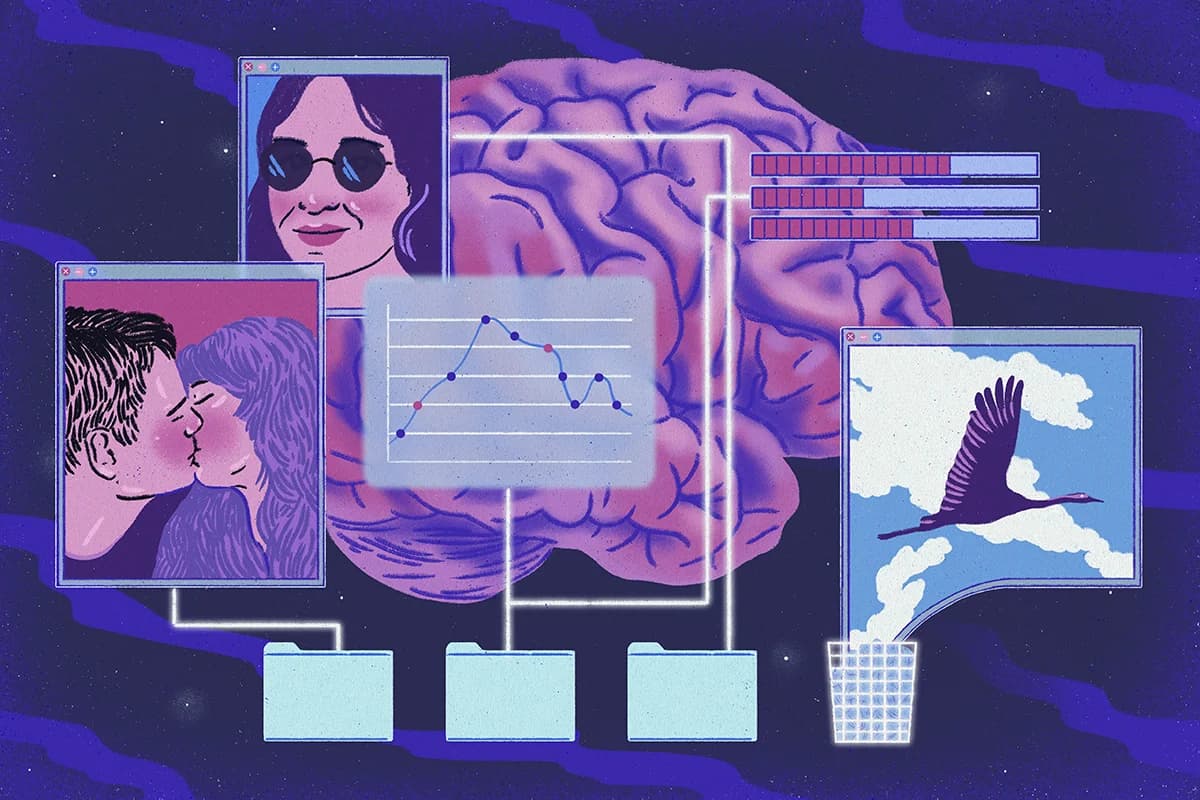
The best-known theory is that dreaming is part of how your brain files away the day. While you sleep, the brain replays recent experiences and ties them into older memories, and people who sleep after learning something remember it better than people who stay awake. What's less clear is whether dreams have anything to do with it.
In one experiment, 99 students spent about 45 minutes learning their way around a 3D maze on a computer, then either napped or stayed awake before being tested again five hours later.[2] The nappers improved more, as the researchers expected. The surprise was in what they dreamed. The four nappers who mentioned the maze in their dream reports improved about ten times more than the other nappers. Students who stayed awake and thought about the maze got nothing out of it. And the four dreamers had been among the worst at the maze before their nap, as if the brain dreams most about what it finds hardest.
The maze in those reports was nothing like a replay, though. Two people heard the music from the game, one thought about the test to come and three described other places that felt like mazes. That fits what the brain seems to do with memories in sleep, mixing them into what you already know more than rerunning them. The researchers were careful about what this means, and they don't think the dream caused the improvement. In their view both come from the same memory work going on in the sleeping brain, so a dream about something you've been learning is a sign that the work is under way.
If you've ever dreamed of an exam, a new job or a language you're learning, set somewhere it has no business being, this is the likeliest explanation. But it's also the theory closest to what sleep in general does for memory, so the hard part is showing that the dream adds anything to the sleep.
2. Dreams take the edge off emotions#
The second theory says dreams work as a kind of overnight therapy. They go back over what upset you during the day, in a setting where it can't hurt you, so you wake up with the memory and less of the feeling. It explains why so many dreams are emotional, and why the people and worries in them are so often the ones already on your mind (dreams borrow heavily from your waking life).
Some of the most convincing evidence comes from people going through a divorce. One research team followed 61 people around the time of their separation and recorded their sleep, waking them from REM sleep to collect their dreams. A year later they tested them again.[3] Among those who were depressed at the start, the ones whose bad dreams came early in the night and eased off towards morning were more likely to have recovered a year on. Those whose bad dreams piled up towards the end of the night were more likely to still be depressed. It looked as if the dreams were working through the hurt over the course of the night, and in some people the work stalled before morning.
A more recent study found something similar with fear. People who had more fear in their dreams reacted less strongly, in body and brain, to frightening images when awake. In them, an area at the front of the brain that helps keep emotions in check was also more active.[4] The researchers think a frightening dream may work a bit like practice at being afraid.
The same researchers see recurring nightmares, like the ones that follow a trauma, as this process failing. Those are worth treating, and the guide to what causes nightmares covers the method sleep doctors use. If you'd like to work with your dreams through a hard time on purpose, using dreams for healing goes further.
3. Dreams rehearse danger#
Being chased, falling, getting lost, sitting an exam you didn't know you had: when people list their dreams, a lot of them involve something going wrong. The Finnish cognitive neuroscientist Antti Revonsuo took that seriously and argued that this is what dreams are for.[5] In his threat simulation theory, the dreaming brain runs drills of dangerous situations so that we get better at spotting threats and escaping them. It's a skill that would have kept our ancestors alive long before anyone had an exam to fail. If dreaming is that old, other animals should do it too, and there's good evidence that many of them do.
The theory predicts that people who live with real danger should dream about it more. Revonsuo's group tested it on Kurdish children who had lived through severe trauma, and compared them with Kurdish children who had been through less and with Finnish children growing up in safety.[6] The most traumatized children reported more dreams, and their dreams held more threats, and more serious ones, just as the theory predicted.
It fits nightmares and chase dreams well, but the rest of our dreams less so. Plenty of what we dream has no danger in it at all (a chat with a friend, a walk through your old house). And what does a drill achieve if you forget almost all of them by breakfast? The theory also says these drills mattered most in the distant past, which is the hardest thing of all to test today.
4. Dreams keep the brain from getting stuck in a rut#
The newest theory comes from an unexpected place, artificial intelligence. When a computer network is trained for too long on the same examples, it gets very good at those examples and bad at anything new, a problem called overfitting. Engineers fix it by feeding the network noisy, distorted versions of its training data. The neuroscientist Erik Hoel has argued that dreams do the same job for the brain.[7] After a day of learning, the brain makes up strange, warped versions of experience overnight, so that what it learned stretches to situations it hasn't met yet.
The idea is appealing because it explains how weird dreams are, the part the other theories struggle with. If dreams were only for storing memories, why would they twist them so much? In Hoel's view, the weirdness is the point.
It is the very strangeness of dreams in their divergence from waking experience that gives them their biological function.
It also fits something you may have noticed yourself. Spend a whole day on something new and repetitive (Tetris is the classic example) and it tends to turn up in your dreams that night. It's never an exact rerun, but an odd version of the task. The theory is young, though, and so far it rests on that kind of fit more than on experiments built to test it.
5. Dreams are a by-product#
The last theory says there's no purpose to find. In 1977 two Harvard psychiatrists, Allan Hobson and Robert McCarley, proposed that during REM sleep the brainstem fires off bursts of signals more or less automatically. The rest of the brain then does its best to make a story out of them with whatever memories it has to hand.[8] They called it activation-synthesis. On this view the story is the brain's best guess at a pattern in noise, a bit like a face you see in a cloud, and its oddness comes from the way the brain works in sleep, not from a hidden message.
That put them at odds with Freud, who had argued that dreams are disguised wishes and that their strangeness is the disguise. But the strict by-product view has had troubles of its own. Dreams turned out not to need REM sleep or its brainstem bursts, since you dream in non-REM sleep too. And what we dream is far less random than a story stitched together from noise should be, because it follows your worries, your relationships and what you've been learning, as the first three theories show.
Which theory is right?#
Probably several of them, each for a different part of the story. The memory and emotion theories describe things the sleeping brain clearly does, and the open question for both is whether the dream you experience is part of that work or only its echo. The threat and overfitting theories try to explain why dreams look the way they do, and both are hard to test. And the by-product view keeps everyone honest by asking whether a dream has to be for anything at all.
Every theory also has to live with the fact that you forget most of your dreams within minutes of waking. If dreaming has a job, it does it whether or not you remember the dream, the way your heart keeps beating without your attention. It also means the dreams you remember are a small and lopsided sample, mostly the long, vivid, emotional ones from just before you woke up (why we forget our dreams explains why so few survive). What none of the five supports is the idea that dreams bring messages from outside your own head, or that they can predict the future.
What it means for your own dreams#
Not knowing which theory is right doesn't leave you empty-handed, because all five agree on what a dream is made of. It's built from your own memories, worries and recent days, put together by a brain that's working on them in ways nobody fully understands yet. So the dreams you remember do tell you something real about what's on your mind, even if they don't come with a code to crack (making sense of them is what dream interpretation is about).
Some of what the research found is worth taking to bed with you. A dream about the thing you're struggling to learn may be a sign that your brain is still working on it. A frightening dream now and then isn't a bad sign either, since fear in dreams went with calmer reactions during the day. The ones to take seriously are the nightmares that come back night after night, because that's where the emotional work seems to get stuck.
If you'd like to see this in your own nights, the only way is to catch the dreams before they go, and Oniri's dream journal lets you say a dream out loud before you've even opened your eyes. Note whatever is left in the first minute after waking, even if it's only a feeling or a single place. After a few weeks you'll see what your brain keeps coming back to at night, which is more than any of the five theories can tell you about yourself.
Vanliga frågor
What happens in your brain when you dream?
Some parts of your brain get busier and others go quiet. In REM sleep, when the most vivid dreams happen, the areas that handle emotions and visual images are very active, while areas at the front that handle logic and self-control are turned down, so dreams feel intense and you rarely question them. In every stage of sleep, dreaming goes with a drop in slow brain waves in an area at the back of the brain.
Why do we dream about certain people?
Mostly because they matter to you or have been on your mind. Dreams are built from your own memories and worries, so the people who turn up most are the ones in your life now (a partner, family, friends, colleagues) and anyone who stirred a strong feeling recently. Someone you haven't thought about in years can appear too, often because something in your day brought back a memory of them.
Does dreaming about someone mean they're thinking about you?
No. A dream is made entirely inside your own head, from your memories and feelings, so it tells you about you and not about the other person. Dreaming of someone usually means they've been on your mind, or that they stand for a situation you're dealing with. There's no evidence that dreams carry messages between people, any more than there is that dreams can predict the future.
Why are dreams so weird?
Dreams are weird because the parts of the brain that check logic and keep track of time and place are much less active in sleep, while the areas that make images and emotions keep going. Scenes switch without warning, a friend has a stranger's face, and you accept all of it. One theory even says the weirdness is useful, because odd, distorted versions of your day help the brain apply what it learned to new situations.
Do we dream in color?
Most people say they dream in color, at least some of the time. Age seems to matter, though. In one study, people who grew up with black-and-white television and films reported more black-and-white dreams than younger people who grew up with color, which suggests that what you watched as a child can shape how your dreams look. People born blind don't have visual dreams at all and dream in sounds, touch, smells and tastes instead.



Källor och referenser
Den här artikeln bygger på publicerad forskning, peer review-granskade studier och pålitliga böcker. Kolla källorna nedan om du vill gräva djupare.
[1]The neural correlates of dreaming
Siclari, F., Baird, B., Perogamvros, L., Bernardi, G., LaRocque, J. J., Riedner, B., Boly, M., Postle, B. R., & Tononi, G. · 2017
Nature Neuroscience, 20(6)
[2]Dreaming of a learning task is associated with enhanced sleep-dependent memory consolidation
Wamsley, E. J., Tucker, M., Payne, J. D., Benavides, J., & Stickgold, R. · 2010
Current Biology, 20(9)
[3]Role of REM sleep and dream variables in the prediction of remission from depression
Cartwright, R., Young, M. A., Mercer, P., & Bears, M. · 1998
Psychiatry Research, 80(3)
[4]Fear in dreams and in wakefulness: Evidence for day/night affective homeostasis
Sterpenich, V., Perogamvros, L., Tononi, G., & Schwartz, S. · 2020
Human Brain Mapping, 41(3)
[5]The reinterpretation of dreams: An evolutionary hypothesis of the function of dreaming
Revonsuo, A. · 2000
Behavioral and Brain Sciences, 23(6)
[6]The threat simulation theory of the evolutionary function of dreaming: Evidence from dreams of traumatized children
Valli, K., Revonsuo, A., Pälkäs, O., Ismail, K. H., Ali, K. J., & Punamäki, R.-L. · 2005
Consciousness and Cognition, 14(1)
[7]The overfitted brain: Dreams evolved to assist generalization
Hoel, E. · 2021
Patterns, 2(5)
[8]The brain as a dream state generator: An activation-synthesis hypothesis of the dream process
Hobson, J. A., & McCarley, R. W. · 1977
American Journal of Psychiatry, 134(12)

Skriven av
Founder of Oniri
Jean-Baptiste founded Oniri and researches dreams, lucid dreams, creativity, and AI. He collaborates with the Sleep and Cognition Neuroimaging Laboratory in Geneva and is invested in different studies about lucid dreams and the intersection of dreams and AI, including a paper in the Journal of Sleep Research on cathartic dreams.
Dela artikeln